The future of rock-and-roll is safe in the hands of Neptune’s Core, a band made up of two sets of sisters: Sofie Richter (lead vocals and guitar), Hannah Richter (bass), Jackie Cywinski (vocals and guitar), and Kaitlin Cywinski (drums). With roots stemming from Chicago’s ever-blooming music scene, the last decade of playing gigs, writing music, and deepening an already cosmic chemistry all culminated in the release of their debut album, Pivot –– an 11-track earworm that pulses with powerhouse melodies while offering lyrics that sink its teeth into vulnerable introspection.
We sat down with the band to chat about the becoming of Neptune’s Core, sibling telepathy, and what the making of their record unveiled about each of them.
How did Neptune’s Core form?
Kaitlin: Jackie and I are sisters, and Sofie and Hannah are sisters. Jackie had played music growing up, which inspired me to get into it when I was around 12 or 13. Sofie was always singing. We came together with some friends and started playing covers for open mics, and eventually that spiraled into us four solidifying as a unit and writing our own songs.
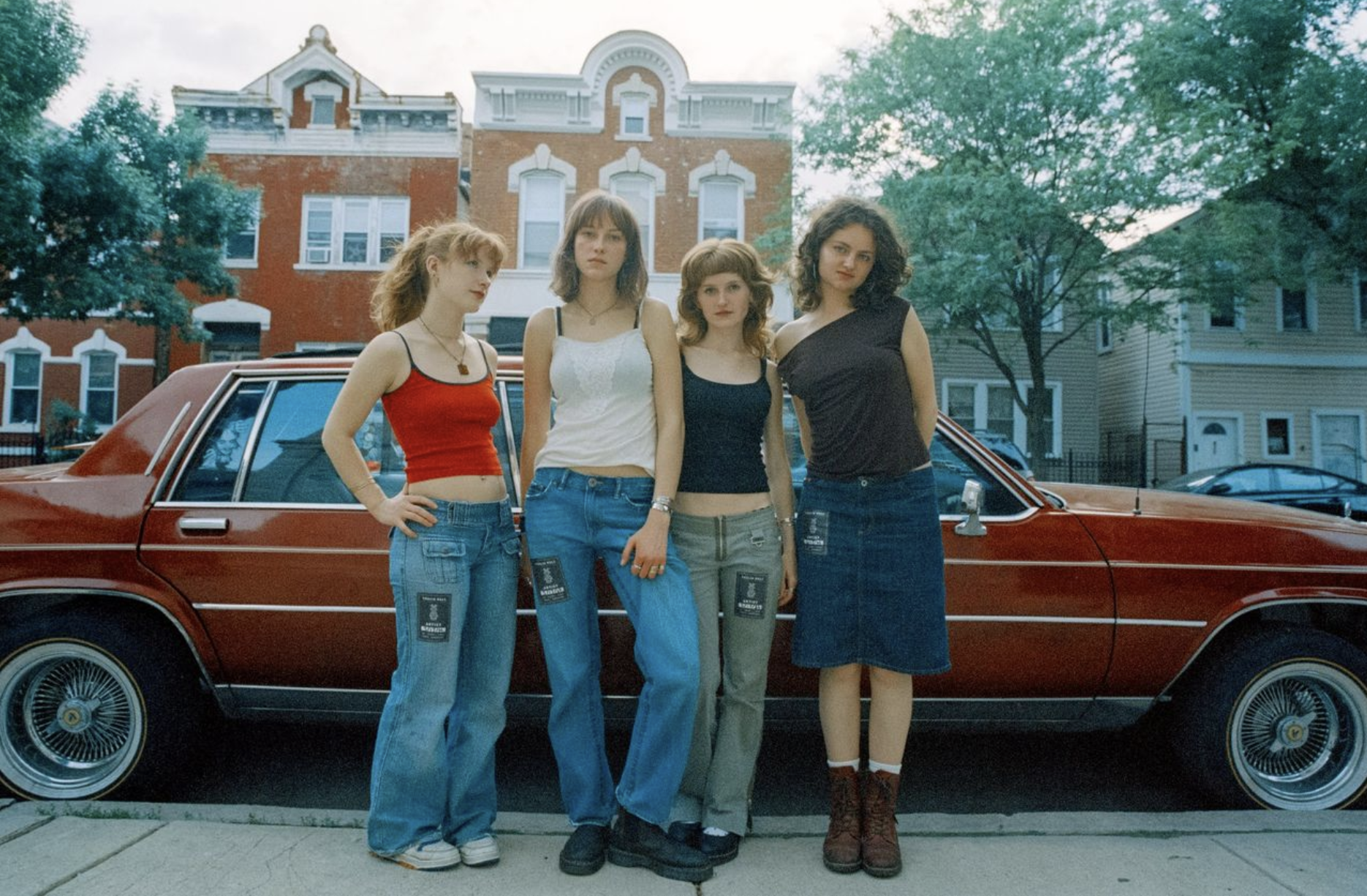
Photo by Miles Kalchik.
You guys have a special dynamic being made up of two sets of siblings. What does working with a sibling unlock in the music-making process that you think wouldn’t come about in a normal band?
Sofie: I think it really helps with the songwriting process because I'll take a song to the band and have my ideas worked out, but it's up to them to create their own parts. It just so happens that the parts that Hannah, Kaitlin, and Jackie create are my definition of perfect, and it works out so well. There's some sort of telepathy that we have when we're in this flow state of writing where, with a couple of run-throughs of a brand new song, we're able to lock it into what we deem to be the perfect version of it. There’s so rarely an argument when it comes to the creative process. We all have very similar values in songwriting and a similar idea of how we want the song to go. It's really helpful that we're all sisters.
Kaitlin: It helps us develop a really deep sense of trust through the open communication that we're able to have about everything. Honesty comes very easily, and I think that's important when you're writing music and taking emotions from your soul and putting it into art.
Jackie: Being sisters is our superpower. We understand each other and communicate like no other band. We’re a very close unit.
Hannah: We probably fight more than most bands, but we make up so much quicker, so it doesn't even count.
How do you guys navigate conflicting ideas when making creative decisions? Do you function as a unit or as individuals in these situations?
Hannah: We're very much a unit.
Jackie: We think about how the product will sound as one piece when we're making decisions like that, but of course we all have our own opinions. Sometimes, I see a vision for a product one way, and maybe Hannah will think of it another. We do butt heads, and that's natural, but as long as we're not yelling at each other about it, it’s fine. Even Hannah and I, who aren't siblings, argue about it like siblings. We know we all have the same end goal of making a product we're proud of, so there’s never any hard feelings.
Kaitlin: The most creative disagreements occur not necessarily with the songwriting, but maybe with the mixing process and the recording process, and how we want certain elements to sound. We all somehow usually align on the same overall feeling and construction of a song, but when it comes to specific details, that’s when sometimes there can be slight differences.
[We] think about the song as a whole and not like, “I really need my part to shine right now.” That’s never a goal that any of us have in mind. It’s just making the best one song that represents the four of us as a unit.
Hannah: We definitely write with each other in mind. Personally, I'll never be –– like Kaitlin was saying –– “I want my part to shine.” I'd be like, “This complements Jackie's guitar part really well,” or “I'm playing perfectly with Kaitlin's drum part.” It's never like one of us needs to be the center of attention.
Sofie: When it comes to having different opinions, we all really respect each other. Sometimes if there's an opinion, I'll be like, “Maybe they're actually right” because they tend to have some brilliant ideas. I don't think we enter it with any sort of individual superiority. I think we all really respect each other's creative minds.
Could you talk to me about the timeline of a song? Where does the seed begin, and how do you know when it’s finished?
Sofie: I'd say it depends. With “Cut My Garden Bare,”for example, I was in the shower, and the melody came to me randomly, and I got excited about it. I had a lyric or two and pinned it down with the guitar, and started to structure the song. Lyrics always come last for me. I'll get the melody going, and you'll hear a lyric or two maybe in a voice memo, but I'll decide at the end what I want the lyrics to actually be. And then I'll take it to the band.
At this point, the song is on an acoustic guitar. It's not quite what it is [with a] full band. There's a lot of room for Kaitlin, Hannah, and Jackie to add. It's a very collaborative process.
I love how there’s an urgency in the instrumentals of “Cut My Garden Bare,” but also how it's tangled in lyrical metaphors that are intimate and vulnerable. There’s an interesting dichotomy between these two elements that I often see throughout your songs. How do you go about intertwining them?
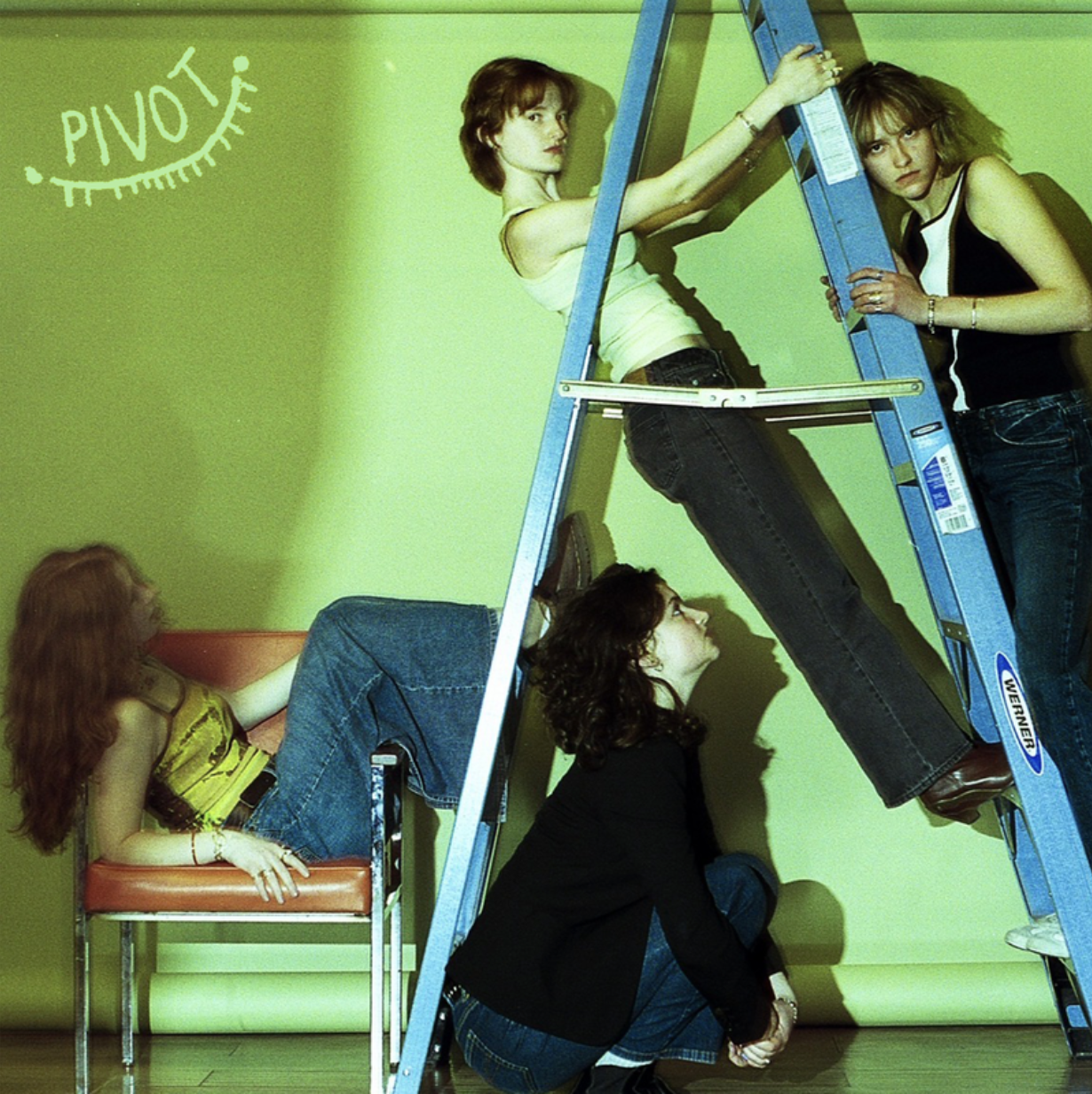
Pivot album cover.
Kaitlin: I feel like the difference can be reflected between the seed of the song versus the four of us collaborating. It’s funny you bring up how the instruments feel powerful. I almost think about it as me, Jackie, and Hannah coming to support and lift up the message that Sofie’s presenting through her initial lyrics and melody, and we all then add our own parts and build on it. You can almost tell that the initial part of the song came through one thought process, and the power comes from a family coming together and lifting that up.
Sofie: We know each other so well, and that really lends itself into knowing what part to add. Emotionally too, most of the songs are quite vulnerable. It’s a safe space to bring that emotion, and we can instrumentally match that. Typically, like with vocals, you can hear the emotion if the voice cracks or if the lyrics are sad or whatever, but [it’s] the ability of Kaitlin, Hannah, and Jackie to still evoke emotion with their instruments and all contribute to the same theme.
What was the catalyst for your upcoming album, Pivot? Do you think it’s a full shedding of who Neptune’s Core was, or is it more of an evolution?
Hannah: Everything goes back to when we opened up for Dhed in 2022. I think that's when we solidified that we wanted to take things more seriously. We released our EP Called Upon and realized those recordings were beautiful and have such a distinctive sound, but maybe we wanted to get into other sonic elements. Our catalyst was then wanting to record new music.
Scott Tallarida from Trigger –– that's who we recorded with –– did Friko’s Where we’ve been, Where we go from here album. He reached out to us and was like, “I'd love to record a song with you guys for free so you guys can see what the studio is like, and then maybe we can work together further down the line.” We recorded the song “Box” with him, which is a single we have out. [We got] a taste of his engineering process, and I think that inspired us to go into the studio and record a bunch of music we had.
Kaitlin: I would say Pivot is a combination between an evolution and the shedding of our skin. We want it to be a new representation of who we are, but also what we've done in the past has built up to this moment. That’s still important to recognize.
But we do want this new image to be recognized as who we are now with the new sound we're creating. I think that’s why we called it Pivot — because it's presenting a new image, but it's not neglecting the fact that there's a path.
Have you ever had questions about emotions or perspectives you’ve been searching for answered through your own lyrics? Is there a song that serves as this catharsis for you on the new record?
Sofie: I love that question. When I write lyrics, it’s not like I’m 100% aware of why I’m writing them. A subconscious takes over and seeps into the lyrics. When I go back to reflect, I’m like, “Oh, wow. That’s what I was going through, and I wasn’t reckoning with it until now.”
“Arc” is a good example. The ending of the song is a whole thing where I’ve got everything I need –– it’s almost this positive talk where I’m like, “I’m fine, I’m fine, I’m fine.” But then I reflect on it, and it’s like, “Oh, I think I’m just telling myself that when I’m not actually fine.” It all culminates in the lyric, “I’ve got everything I need and loving you is not right for me.” It's kind of an epiphany, but also an epiphany that you’re stating [in order] to realize it. It’s not 100% that I've reached total clarity and am singing this, so it’s all good. [Instead] I'm realizing this as I'm writing it, and this is a process which I think comes through in the song.
Songwriting is therapeutic for me, so I think that's probably why it tends to be like that. We produce vulnerable songs because they come straight from my heart. There's no censoring. It's almost so exaggerated in a way because it's just pure emotion.
In tracks like “Arc” and “Wash,” there’s a lot of movement –– demanding instruments coincide with vibrantly stacked vocals –– whereas a song like “Skeleton” is more stripped-down. I feel like these arrangements bloom from pillars you guys set up as a band to create without restraint. What does surrendering to the process look like for you guys?
Jackie: That's a really good question. I think that it can be kind of hard. With my songwriting –– I wrote “Skeleton”–– I feel like I've had trouble writing songs recently. It can be very vulnerable to even just sit down by yourself with only your thoughts and true emotions. No matter how many times you've felt something or tried to understand it in your head, to say it out loud and put it into a song for a bunch of people to hear is a step that's really scary. I think the thought of it can prevent you from writing something altogether.
But every time you're able to do that, it makes it so worth it. To have a product you're proud of is amazing. I definitely think it can be scary to surrender and fully be yourself in the process, but when it happens, it's always really beautiful. There's never been a time that I've regretted being vulnerable.
Sofie: That’s so true. I don't think I'm consciously thinking that what I'm doing is vulnerable, even though it is. It really helps to be creating music with my best friends and sisters because when we're together, I am always 100% me. I'm not thinking. I'm not controlling myself. I'm not censoring myself at all. So of course when you’re creating music, it lends itself to that.
For me, it doesn’t feel too hard to be vulnerable because I'm lucky to have done it for a while. It can be hard when performing to revisit old emotions.
Jackie: You’ve definitely had a growth process for it. In performances, I know you used to really struggle with that. There’s some compartmentalization you have to do because it used to be every time you performed, you put yourself back in that painful moment, and that became a lot. You’ve learned to treat it like a performance because it gets to a point where it’s not good for you to keep going back to all those dark places you wrote songs about.
Sofie: I agree. It helps when I talk to someone after, like an audience member or a friend who hears the song, and they tell me that they relate to it because it doesn't feel like I’m standing there naked or vulnerable. I'm like, “Oh, you’re there with me.” Even though I'm the one performing, I’m also performing with [the band], and we're all giving our emotions into this performance. We’re also surrounded by people who know these feelings, too. Hopefully it helps them to hear this.
What artists were you listening to or mediums you were consuming around the time of making the record? Do those influences peek through any songs?
Sofie: Finom is a really good influence. They have fantastic harmonies, and they’re brilliant with the dissonance they use. It’s pretty out there, but in a way that’s so captivating and pleasing to the ear. It’s really sophisticated. I love what they’re doing. They’re vulnerable, and their lyrics are metaphorical. They’re fantastic people and great role models. I’ll always be a true lover of them.
Jackie: Courtney Barnett, I was listening to a lot. She has the best storytelling and lyricism. Even the way she delivers her lines –– it's almost a mix between singing and talking. I feel like Adrienne Lenker does it, too. There's a cadence to it that’s not typical of a song. I love that type of singing. Both of their guitar playing is also amazing. They know how to keep all their parts busy, and there’s always something exciting going on. The way the guitar and the vocals complement each other, I really love. That’s something I try to do when I’m playing guitar and singing harmonies with Sofie.
Hannah: Hinds is another big one. They're a girl duo as well that both sing and play guitar like Jackie and Sofie. They’re always having fun on stage, and that’s the goal –– to be so happy and overjoyed that it's radiating off of you into the audience.
If you could each pick a song off the record that resonates the best with yourself in this season, which ones would they be and why?
Kaitlin: They've heard me say this a thousand times, but my favorite lyric on the record is “cut my garden bare,” specifically in the chorus. It’s so powerful and such a vulnerable and deep thing to put in a song, but it’s something that is very human, as a lot of people go through different stages of life. It’s something very relevant to a lot of people. I really love the lyrics in that song and the power behind it.
One of my favorite songs is also “Cavalry King” because it's so fun. We’re all big dancers when we go to concerts, and to have a song of ours that feels like I can let loose and dance to is really fun.
Jackie: I'd say I relate to “Skeleton” because it's the one I wrote. But I also think that “Cavalry King” and “Wash” are two of my favorites. I feel like they're little hidden tracks on there that I love. They’re really fun to dance to, like Kaitlin said.
Hannah: I'd say “Skeleton,” not even in a melancholy way because it's obviously a sad song, but I feel like I'm entering an era of my life where it’s the years people look back on and are super nostalgic about, and it’s making me almost pre-nostalgic for it. I feel like “Skeleton” gives me that nostalgic vibe. It’s a reflective song, and I'm reflecting a lot as I grow older.
Sofie: I would actually say “Lemon Car.” That song is about friendship. As I'm growing older –– I'm currently in college –– there's two different worlds I’m in, friendship-wise, and I’m navigating who is in my life and what they mean to me. I'm someone who wants to preserve friendships, but of course things change, and so dealing with that, I think “Lemon Car” is resonating with me.
I feel like Chicago’s music scene emulates pure camaraderie between all of the acts that come out of there. How has the city’s community influenced your growth as performers?
Jackie: I don't think we would be where we are today without the Chicago music scene. We were raised on a lot of Chicago music with The Smashing Pumpkins and Veruca Salt, and going to concerts with Wilco, Finom, Twin Peaks, Liam Kazar. There's a whole amazing crew of people that really inspired us. Now being a part of it is such a special thing, and they're all welcoming people. It’s a very creatively stimulating environment to be around.
Hannah: I don't think we would have had the confidence to be a band and put ourselves out there if we weren’t in the Chicago music scene because everybody has been unconditionally kind to us. If somebody was like, “Your music sucks,” then I would immediately shrink into myself. But the majority of the scene has been very, very kind.
Kaitlin: I think Chicago is very rare in having so many small venues, which is amazing because as a small band you're able to work your way up and meet amazing people along the way. We started out playing open mics at Old Town School of Folk Music, and to move from that to an opening slot at Schubas to an opening slot at Metro to then Thalia. We'll be headlining Lincoln Hall in December. It feels like there’s levels that you can take in Chicago, which is really helpful in being able to organically build momentum over the years. Also, all the street fests are a huge opportunity for growing artists.
Sofie: We've met so many people who care about us and want to see us succeed. There's a lot of selflessness in this scene, and a lot of love.
There's this fest called Postock run by Sima of Finom, and there’s a lot of staples in that scene that are also great role models for us. They do so much amazing shit musically. We're so immersed when we're seeing them live. But also as people and what it means to be a musician outside of playing music and to support each other.
Kaitlin: The way Sofia Jensen from Free Range or Bailey, who plays with Free Range, but is in Friko –– the way they conduct being a musician and playing in so many other people's bands –– you’ll see them play live, and they'll be the lead person writing music, playing guitar, and singing, but then they'll be sitting back playing bass in someone else's set. That's amazing. Everyone's super interconnected.
How would you describe this next chapter for Neptune’s Core in three words?
Sofie: Honest punch, maybe?
Kaitlin: Honest punch? That’s like the next house band you see.
Sofie: We don’t play.
Kaitlin: [laughs] Watch out, guys.
Sofie: We mean business.
Hannah: Here we come.
Kaitlin: Here we come is awesome.
Sofie: That’s it! Here we come.