Joshua Jensen Dreams in Song
For Joshua Jensen, the hard part of making music isn't coming up with the song itself; it’s trying to write it down on paper. The Arizona-born singer-songwriter has found that songs tend to hit him when the time is right, but oftentimes, they begin as a dream.
In July, he released his first single, “Hoping.” With hallowed vocals, bounding guitars, and a chorus of voices, the track declares that hope, like his songs, often starts as a distant, fragmented concept. But if you trust it, it will find a way to ground itself.
His next dream became “People Were Singing,” Jensen’s newest single released on Sept. 22. This track is softer, blending heavy hums, swelling strings, and a spiritual soul influence to carve out a new signature sound, leaving us all wanting more.
Off The Record sat down with Jensen just before the release of “People Were Singing” to talk hope, harmonies, and honesty through song.
Off The Record: I just wanted to start with some background on you. I know that you have always been very musical and grew up in a musical family. How did this inform your path to finding what kind of artist you wanted to be? When did you decide that you wanted to pursue this path full time?
Joshua Jensen: As a kid, my family would sing around the campfire. We would sing as a family every day, and it was a very natural part of my life. Then I thought: how can I use music to learn about parts of the world I don't know yet? Kind of as a medium to learn. It was also a way to soothe my mind after the day. Whatever happened that day, it didn't matter because we would all be around, singing in harmony, trying to find our place in the song. That's still how I think of music; it's a way to process the things that we're going through. Ultimately, I felt like pursuing music is probably the best way to become the best version of myself that I can be, literally just as a form of betterment, to better myself and to give myself the opportunity to serve the world. I think music is the best way to do that.
Off The Record: Was there a song that you guys would sing together that was really memorable?
Joshua: There's a few! There's this one song called “Cool Clear Water.” It's kind of just an old cowboy song; Marty Robbins has sung it. Roy Rogers has sung it. Joni Mitchell did a cover of it. It's an American-folk tune. And “Sinnerman,” we would sing “Sinnerman.” We would sing old hymns, gospel hymns, church hymns. I think a lot of those songs just have the best melodies ever. They are just so beautiful, and their messages are all so universal, you know? It's not really about one person's life. It's kind of about a collective experience, which I think is really special.
Off The Record: Do you think that those artists or those songs inspired your music today? Who are some of your inspirations for your current musical happenings?
Joshua: I'd say I didn't even know that an artist was a thing until I was in high school. I thought there were just songs, and people would put them out online. I didn't really know that people became musicians as their life’s work. But in high school, my mom would put me on all kinds of stuff, like George Benson, I love George Benson, Algero, obviously Stevie Wonder, Earth, Wind and Fire. I loved Take Six. I would analyze the crap out of those harmonies just to see if I could figure out what they were doing and what the chords were. I'd sit down on the piano and try to listen and hear what they were doing. Then I'd say I discovered songwriters singing with their guitar and kind of took inspiration from them. I think I've brought that into my current project, which is a lot of guitar-based songs, but I'm trying to pull references from a lot of my inspirations. There's classical stuff. I grew up as a classical pianist, and so I'm taking inspiration from that. I'm taking the cinematic part of that as well, bringing that into the music, which is interesting because a lot of people reference my music as cinematic folk music, but when I'm writing and when I'm making it, it all feels super real and honest and exactly the way I want it to be expressed. I'm never going after a huge scale of let's see if I can make this feel like a movie. To me, music already feels that way, so people receive the most honest version of my music and interpret it in their own way, which is amazing. The only thing I can hope for is that it does bring an imaginative image to their mind. If it brings this wanderlust feeling, then incredible.
Off The Record: I feel like you also hear that in your lyrics, too. They’re very raw, which is interesting because I was listening to the first song that you released. It's instrumental, right? What went into that creative choice of not even having any words?
Joshua: I decided about a year ago to write this short string piece as a prelude to my whole discography and try to find some of the DNA of the songs that I would then write. It's kind of a secret, but in that song, there are references to melodies that I'll use later on. There are melodies from “Hoping” in that song; there are melodies from one of my future songs, “Favorite Blue.” There are melodies from “People Were Singing” in that song. I wanted to include those little Easter eggs as a way to present them first in a somewhat orchestral, string-quartet way, because that's where I started in music. My first love was orchestral music. Listening to string quartets as a 12-year-old and just becoming obsessed with the emotions that they brought out. It just felt like a good way to nod to my childhood self a little bit.
Off The Record: Yeah, definitely. Well, now you have lyrics! You have all these crazy harmonies and everything. Where does a song start for you, and what is your songwriting process after that?
Joshua: I try to live my life in a way that lets the song arrive whenever it needs to. Whether that's just having the space to do so, having the instrument to do so, I write a lot of fragments in this big note sheet, and I'll write lyric fragments. I'll take little voice memos. I try to let those stay fragments. Let them just be pieces and never try to force them into something. Then I wait for the day, and some days it just kind of hits me, and something comes, and I can pull it down and write it down. I think that the first song on this project, “Hoping,” and other songs came from a super rough place. And I usually will have a dream of a song before I actually write it. “People Were Singing” was a literal dream that I had, and I woke up the next day and just wrote the whole thing. I knew exactly how I wanted the production to sound. I knew exactly what the strings were gonna do and when the band was gonna come in. All I had to do was get it into a session in Logic Pro, record it, and get the image in my mind onto paper, basically. That's how that one started.
Off The Record: Does that ever feel hard to put this dreamlike thing into a Logic Pro or on a sheet of paper?
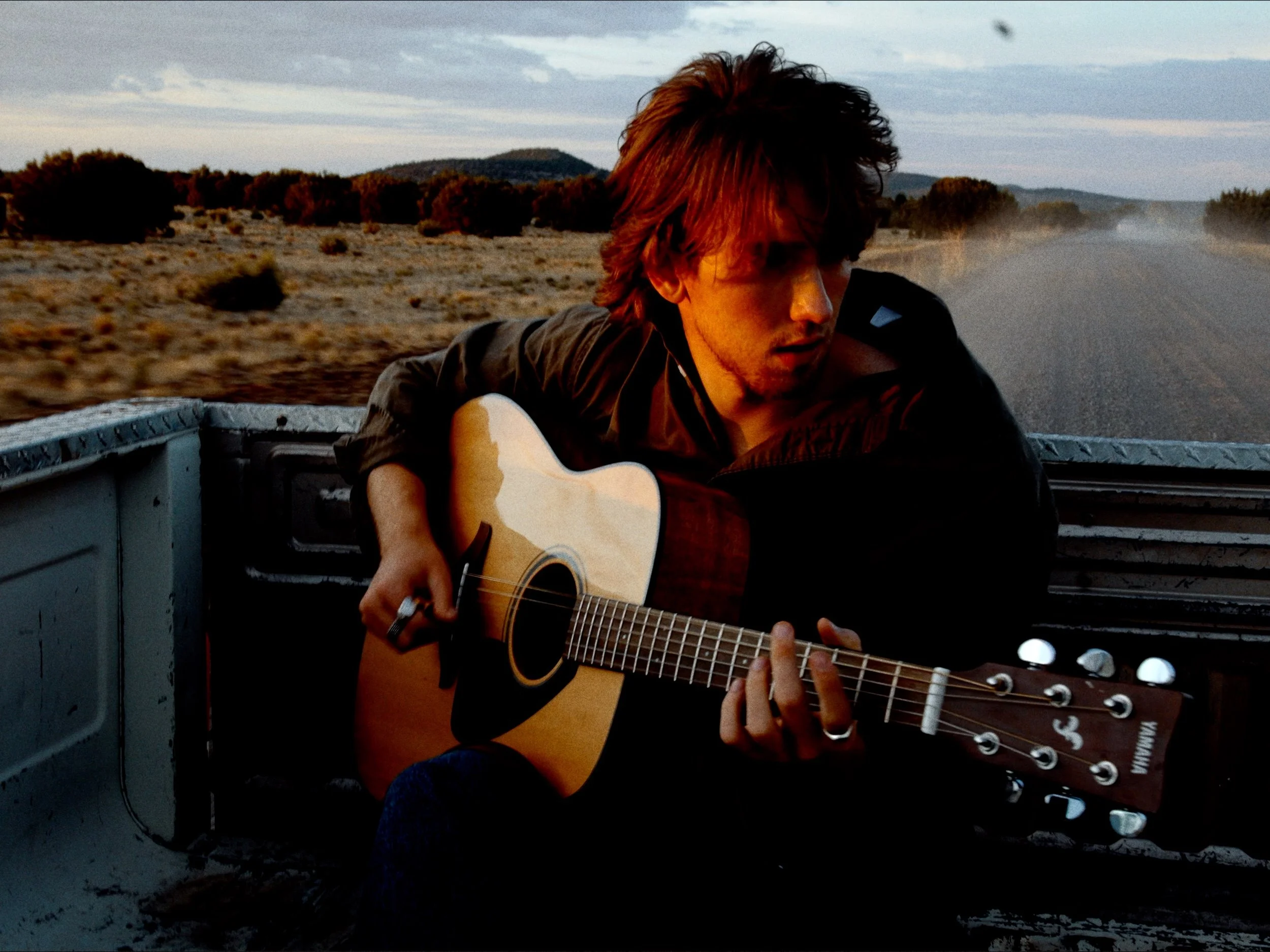
Joshua: Yeah. I think it takes a lot of practice to do that; it's almost separate from just being able to play the guitar or the piano. I think the practice of hearing an idea in your mind and translating it into the real physical realm is something that the greats of history can do, and they can do it many, many, many times. I'd say a lot of people can imagine the music, and they can maybe imagine something amazing, but they don't know how to get it into real life. I've spent years just trying to do that, making albums’ worth of music that I heard in my mind, just trying to figure out, you know, what are the layers that bring that together. That's kind of what orchestration is too, in classical music. You don't have an EQ bar that you can add. You don't have a plug-in to compress the thing more. Beethoven had to be up at night, thinking about why this flute part didn't come out the way I wanted it to. I've always loved Ravel and his orchestrations. He's considered one of the best orchestrators ever. It's all the same thing to me. It's like producers are basically doing the same thing. They're trying to find a mix of elements that will, you know, hit someone in their heartstrings and make you stop in your tracks, essentially. Give you goosebumps. So I'm always chasing that.
Off The Record: I think that is done well in your music. That definitely comes through. That resonated a lot in “Hoping.” I felt like listening to that one, it felt very big, took up a lot of space. Just talking about “Hoping” specifically, what did having that big sound sort of mean to the song? How do hope and having that big, gospel, choral sound go together?
Joshua: I think gospel music is the best music that exists. It's kind of irrefutable. It's the most energetic, soulful, and powerful music. There's this artist, Shirley Caesar, that I love a lot. She just has the most beautiful music ever. Huge harmonies and huge arrangements. And for “Hoping,” it was like, okay, how do I translate this journey of coming from a dark place that feels very alone into the wide expanse of possibility of life actually being amazing? We can overcome, essentially. The song happened so naturally. I was like, great, the band's gonna come in at this bar, and then the strings will come in next because the character of the song is finally realizing that there's so much more to life than you maybe once thought. It starts on the ground, lying down, and then at the end, you're going after life with everything you have. Even the hard stuff, embracing the distortion of life. Embracing the, I was just saying, the huge sound of hoping. I think there's no other way to do it. You just gotta crank it up and go for it, you know?
Off The Record: You said you write through a character. Do you normally write through a character in your music? Through somebody else’s eyes?
Joshua: I think deep down I have a secret hope that I'm not writing about myself sometimes, but I always am. I always am. I can't help it but be fully honest. And even when I try to do that, even if it takes me a year, I'll listen to it later and realize how true every word is for me. I think “People Were Singing” is definitely like that for me now. When I had this dream and first kind of experienced this, I was like, hmm, I'm going to write about this. I don't really feel much about it. It kind of just happened, and I don't really know what this means. “People were singing,” like, what is this actually saying? I don't really know. I just kind of did that. And then I think now when I listen to it, there's so much more meaning to the words. There's more meaning to the ways that the elements of the song interact with each other. And I think it's cool to let a song grow with you through your life. The best songs do that. The best songs can morph and change and adapt and support you throughout different eras of your life. Those are the songs that you should release.
Off The Record: Totally. I loved “People Were Singing.” The meaning for me felt very much like connection through music and using music as a way to connect with people. I was wondering if that is something that you try to do in your music. Do you want to be able to connect with people through your music?
Joshua: Of course! But I just, at least now, and my mindset might change about this, but right now, I'm thinking about how do I stay grounded and how do I feel really true about the things that I'm making? And all I can do is hope that it connects with somebody, but I'm not trying to start with that first. Whenever someone does connect, I'm honestly like, wow, that's amazing. I'm kind of surprised because this is so personal for me, but I'm glad that you see yourself in this too. That's, of course, the hope.
Off The Record: Music is a very diary-esque way for people to express their emotions, and having someone connect to those really deep emotions that you have must feel pretty crazy!
Joshua: You have to be really open to hearing that and believing it.
Off The Record: I felt like all your vocal harmonies were really unique when I was listening to your music. Do your vocal harmonies represent anyone or anything in your music? What supporting details do they hold?
Joshua: I think there's two answers. The first is that they sound really nice, and it sounds good. The second is that, going on this previous note, I don't often believe people are experiencing the same things I am. Sometimes it's easy to feel very alone. And if you notice where the harmonies come in in a lot of my songs, it’s usually after the thing being said has already been said by one person. But then they kind of are realizing this is a universal experience that a lot of other people have, and I'm not the only one having it. I think that dissipating aloneness is the beauty that harmonies bring. And then there are other times where it’s a completely different character interjecting and saying their own thing, and then the main character kind of reacts to it. I say character, but yeah, it's me. I'm trying to convince you that it’s not me right now, but it is.
Off The Record: It's everybody. It's everybody. The characters, everyone and everything all at once! Finally, I just wanted to ask about the future! You've got “People Were Singing” coming out. Is there any more music coming?
Joshua: There's lots more to come. I have so many ideas. I have so many hopes and things that I've been working on. The biggest challenge will be putting them out with enough space to let people listen. I have so many things I want to put out. These songs leading up to a project will be the first family of tunes. I think it represents almost an origin story, in a way, for me, and presents a good foundation for what is to come next year. We'll say that.