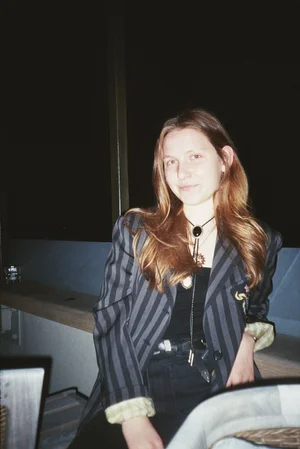
aron! on Too Close For Running!
aron! released his debut album, Too Close For Running, on September 18th. Consisting of twelve songs, the album blends elements of jazz and pop, featuring layers of inviting vocals, delicate guitar riffs, and an intriguing variety of chord progressions across its 36-minute runtime.
Over the last few years, aron! has worked to carve out his own space in the industry with genre-bending jazz that incorporates pop and indie. Described as “cozy pop,” his music is just that, with Too Close For Running serving as a natural evolution of that sound. The album follows a wide-eyed perspective of exploring a new relationship and the emotional experiences that come with it.
We sat down with aron! before the release of Too Close For Running.
Can you first give a brief background into your musical history.
I started when I was eight with guitar. I was playing Guitar Hero with my family, and then I just wanted to do the real thing. And my parents were kind enough to find me lessons with this rock guitarist. But I really got interested in music when I found jazz. And I was with this old guitar teacher when I was in middle school and I would go over to his house and do five hour long lessons until midnight. It was great. And he would mainly just talk about his life for four of the hours and then [the other] one hour we would play music. But it was great. I learned a lot.
What was one of the biggest lessons that you learned from him?
One thing he would say, and I don't know if I really believe this, but whatever you do, you have to be the greatest at it, which is cool. I do want to make great things. But I don't think I have to be the greatest.
Before your solo project now, you were in a different indie band. I read that you said that other people's interest in jazz helped kickstart your project because you realized that people cared about that music. Do you want to talk a little bit about that?
So jazz has always been my guilty pleasure. And the thing that I was trying to do is make music that people want to listen to or what I thought people wanted to listen to. I guess what I realized is I have no idea what people want to listen to because I was just posting Ariana Grande covers. And then I was like, "Oh, well, I like this old song from 1940, so let me just do that." Then people liked that. So sometimes it's the most obvious thing that strikes a chord. But I guess it was that, it was hearing from other people that they like the same music that I thought was my guilty pleasure. And I was like, "Oh, well wow, I didn't know it could be so simple." But now I try to do some blending of the world of pop and jazz.
The first track is “Love Is How you Lose,” how do you think it really immerses listeners into this album?
Yeah, it kind of goes back to the obvious thing. Some parts of this record are bigger. Songs like “Tandem Bike” are big. But the first one is just kind of obvious. It's me with a guitar with words that I like and chords that I like. And so I think it's just a pretty obvious opening.
“Clementine,” I thought it is interesting how the instrumental rhythms match the pattern of the lyrics, especially in the first verse and towards the pre-chorus. And how more instruments get layered and then taken off of the vocals is intriguing. How do you choose how to pair the instrumentals with the vocal rhythms in your songwriting?
My challenge with that song was trying to write a verse with two chords because usually I like a lot of chords. Even the chorus has some weird ones, but I love that the verse is just pretty simple. And when you have harmony that's simple, then you can add other things that are interesting, like the horns or the strings. Sometimes lines just come to you and then you have to figure out what they mean to make the song justify that line.
If you had to pick another song to name the album after, what would it be?
Like a second? I don't know. That's crazy. We were thinking “Clementine” maybe, but I don't know. Too Close For Running captures what most of the record is about just when you're starting to get to know someone, it's all fun and games. And usually you would start to run away because it just starts to get a little scary to that point where it's like, “oh, we're kind of in too deep, too close for running.”
I was noticing a lot of the themes of love and longing of connection. Did you come into creating this album with an idea of what you wanted to talk about or did the themes reveal themselves as you were writing?
I'm pretty into the idea of it that I don't know that much. And so something that's fun for me is letting the song show me the way. I'm just the one who's writing it down. I think that the song exists out there in the ether, and then you just put up your antenna and then you write down what you hear. Part of it is the music will show you the way, and then you make decisions based on that.
On this album, you have two songs featuring other artists, which are so good. “Call When You Can (feat. dodie)” and “Macramé (feat. Mei Semones).” How did you choose which artists to collaborate with? Did you write any of the parts with them or did they come up with their own part?
Yeah, I'm so excited. I mean, I can't believe we got these two people to be on the album. The dodi one was pretty much, I had the song written. I had a verse written too for her spot, and I sent her the song with my verse in. Well, with me singing both verses, she's like, "Oh, great. I'll just re-sing your verse with your words." And I was like, "Wait, wait. No, I want your words." She added some clarinets to my pre-existing clarinets. Macramé, it's with my girlfriend. And I was on vacation with her in Maui. We were in the car and we were driving up a volcano. I was like, “oh my gosh, you should be on this song that I wrote about you.” Which was my little word play, like macrame, Mei Semones. So I wrote the chorus and my verse, but I did not write her verse because she wrote that and she speaks Japanese. And I'm working on my Japanese, however, I do not know any of those words. She also wrote all the crazy guitar parts. At first she was just going to sing a little thing. And I'm like, "No, we want the Mei sauce."
Does your songwriting process tend to start instrumentally or lyrically first?
I used to think that for me, it could only be done if they came at the same time. But then I realized I was wrong again. And so I tried writing words first and then going in with a separate hat. And I was like, "Oh, it works, it still sounds like me." I think for songwriters out there, if you think that you can only write one way, you're probably wrong. Try a different one.
What is one goal you want to accomplish for this year?
Wow, what do I want to accomplish this year? I think I would like to learn how to cook. But musically what do I want to do? I just like writing songs.
Listen to Too Close For Running. Find aron! on Instagram, Spotify, and their website.
All photos by Tori McGraw (@afterr.hourrs)