
Love Spells: Navigating The Laws Of Love
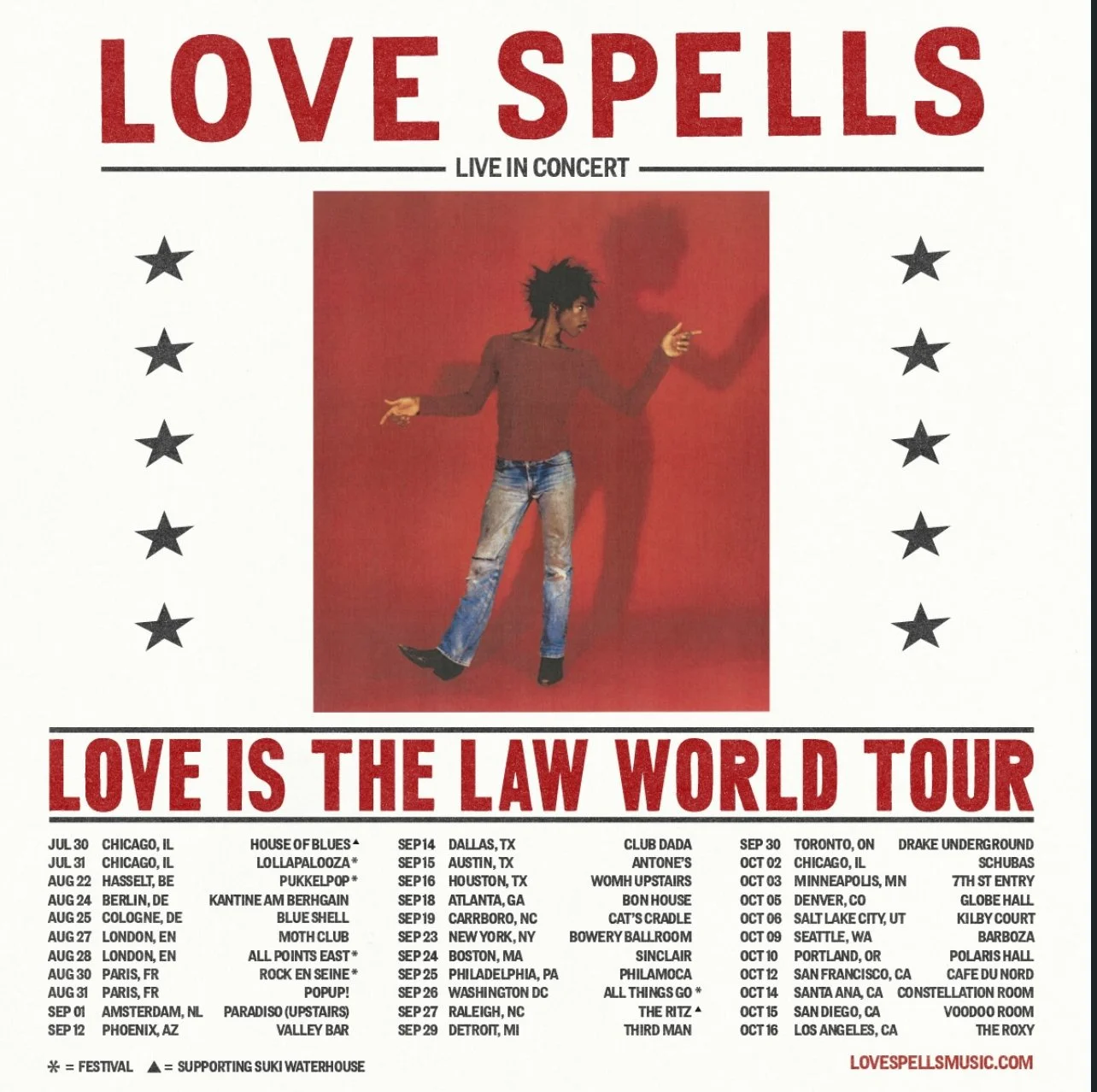
Behind the moniker Love Spells is Teagan, a Houston-born, Los Angeles-based singer-songwriter whose sonic blueprint blurs the lines between raw emotional vulnerability and sharp genre experimentation. Striking out from the deeply rooted musical landscapes of Texas to the fast-paced industry hubs of California, Tegan channels the heavy transition of leaving home directly into his craft. His music is defined by an atmospheric, late-night analog warmth, an open-book approach to songwriting, and an innate focus on movement and community—a feeling heavily inspired by years spent dancing at legendary Houston spots like the new wave nightclub Numbers. Ahead of the release of his highly anticipated debut album, Love Is the Law, Love Spells is stepping into the spotlight, bringing an intimate, therapeutic collection of songs to the stage for a massive headlining festival tour.
Off The Record: On July 24th, your debut album, Love Is the Law, finally drops. I know you've spent years keeping these songs protected, and you're finally starting to kind of hand the keys over to everyone else. How are you holding up with the release countdown, and how does it feel to finally let these songs go to the public?
Teagan: I actually made the album like, in like eight months. So, it wasn't even that long. But it feels good, honestly. It feels like a weight off my chest. In a way of, you know, now I get to finally tell people what I have to say, you know? And that feels good, you know? It feels like a long time coming, even though it hasn't been that long. It feels that way because, you know, the build-up is just this anticipation to it is like, wow. Even now, it's about to be out, and I'm like, wow, what are people gonna say?
Yeah, I feel like sometimes eight months in the music industry feels like years from people that I've talked to before. Like, you working on it every single day makes it feel a lot longer.
Yeah, exactly. So... feels like a lifetime I've spent. Absolutely.
Well, I know you grew up in the Houston, Texas area. I know that you made the jump from Houston over to California, especially to deal with the craft and kind of have more of a grasp on the music industry. How do you think the physical shift from Texas to LA shaped the DNA of Love Is the Law?
I love Texas with every bone in my body. And when I left it physically pained me. I was like oh my god. I always tell people I feel like half my soul is in Texas. I wanted to feel closer to it and my idea of it, you know? There's like two sides of [Love Is The Law] for me, two sides of the same coin. You have that modern, screwed-up rap scene and everything. I did the whole Blush thing, and I felt closer in that way. Then there's the whole country aspect, And there's like, um, all that. And I was like, wow, you know, um... you know, these are—this is another aspect that I love about my city and like, the state, that um, I want to like, explore more. Um... so, that's why there's a lot of like, you know, twang to this album. Way, um... it's honestly just me being homesick.
It's kind of like a love letter back home, in a way.
Yeah, honestly.
I would say there is kind of like a late-night, like, analog warmth to the record, it seems like. I read that while you were writing, you were pulling heavily from memories of nights spent at Numbers, which was a nightclub over in Houston. What can you tell me about the space and how the new wave '80s kind of sound went into your tracks.
It did, but not in a new wave way, if that makes sense. I actually feel like I didn't explore that as much as I could have, which is probably something I'll save for another project. It was more so inspired by the feeling of community that I had there and pure emotion— everyone's just dancing, people I don't even know, it's a continuous community. I go every Friday, and then I get to see these same people, and we start dance together. That's the reminder to me. More of that and less of the music, cause I feel like I'm not ready to dive into the music part of it yet. I like to specify, because if you've been to Numbers, then you might say, “If he was trying to make music like music there, this is not the best representation." It's more so the feeling that I had there. But, Numbers is a legendary spot, I’ve been going for so long. I've spent so many nights with my friends there, so many memories that I feel like that kind of changed me for the better, in a way. It's kind of like an outlet, you know? An outlet for your emotions, and you go there and you get to just dance it all away until like 2:00 AM. And they play amazing like, '80s new wave, and that in itself has like, been the soundtrack to my life since as long as I can remember. So, I have a very deep connection to that music. It's honestly my entire life.
I was going to say, your most recent music videos for "Keep It to Yourself" and "Crutch" seem to have a lot of choreography and modern dance in there. Why do you think movement is such a crucial translation of your lyrics? Becuase as you said, it was more of the vibe and the way it made you feel at this club than it was the music. How do you think choreography and dance kind of goes into your lyrics?
It doesn't go into my lyrics, necessarily, but it goes into the feeling of the song. I don't think about dancing when I'm making the lyrics or anything like that, it's more so, when I'm making it, I'm not forcing it, if that makes sense. But "Crutch," for example, is such a slow song. I was not thinking about dancing when I made that at all, but then when I did play it, the music makes you want to dance. And I was like, wow, I should really express this side of myself more. It feels more honest and it'd be a way to let people know more about me, and just get to know me better. In the way that I do have this song, but showing this is how I feel about the song, this is what it makes me want to do. So, I decided to dance. And that's usually, nine times out of ten, that's the answer to any song I hear or make. So, I just wanted to incorporate that.
Yeah. So, you would say that a majority of the time, when you are writing songs, it's the lyrics that come first.
Yeah? Well, actually no. It's sometimes— half the time I'll say no, because I do like to jam out, and get lyrics later from that. But lately, I have been just coming in with lyrics.
Yeah. So, it's like a little mix between the two. Sometimes it's the lyrics, and sometimes you get the lyrics from something else that you've played.
Exactly.
Well, it seems like "Keep It to Yourself" is kind of—how I took it—was realizing that not everyone deserves access to what's so sacred between two people. Um, nowadays it seems like people very much broadcast their lives, broadcast their relationships, online especially. How do you actively protect your peace in your relationships when it comes to music and also just your online presence as well?
That's a good one. I don't know. In terms of romantic relationships?
Kind of a little bit of both. Like romantic relationships, but also relationships with friends as well, because I know sometimes with an online presence, people can come after more than just romantic relationships.
I'm somebody who doesn't— especially friendships— I don't really let myself be exploited. So, I feel like I have a very good sense of identity, and I'm not afraid of confrontation either, so if I feel like someone's doing something, I'll say it or I'll just depart from the situation. Even relationship-wise, but then again, all my friends here are like musicians, too, so they have their own things going. And if they're not musicians, I just know they're cool, chill people, who like don't really care about that, you know?
Romance-wise is a hard one, because I have not actively been trying to do that with anyone. I don't feel like I can make time for things right now, and if you feel like you can't make time for things, then maybe don't be in a relationship. But I mean, if I was in a romantic relationship, it wouldn’t wouldn't be good for my career, I'd probably choose that too much. I think not letting anything come in and like rain down on a relationship is kind of hard, because when everything about me is so public right now. You’d just have to trust your partner too, you know you also do the same.
Do you think that you could see yourself kind of—I know you said that if you were in a relationship, it would be kind of like a little bit, like, more consuming than your career would be. Do you think that that would heavily influence your music? And do you think you would want people to know that it's influencing your music?
Yeah, people would know it's influencing my music, so it'll be pretty obvious. I mean, I'm kind of an open book when I'm making songs because the song is for me, until they’re not.
Do you kind of use your songwriting as a way to get out all your emotions, not just kind of one or two specific ones?
It's more so the writing that does it for me, you know? The making of the song that is the therapy, and then you have to live with this piece that you made, piece of emotion you made. That's kind of the process for me.
Yeah. Well, I know the album title is Love Is the Law, which is an incredibly bold statement, and it kind of sounds a little bit like a personal manifesto. What do you think is the law of love to you?
I would actually describe it as a "not about me" type of thing. Love has a spectrum, and if I say love Is the law, that can mean anything to anybody. In my head, when I was thinking of it, it's more— and I don't want to put any sort of meaning onto it, but I also actively don't try to. I kind of just take it how it is. It is such a bold statement, and it's such a self-explanatory statement to me, but it's only self-explanatory in the way that you think what you feel from that. And that's kind of what I want it to be. For me, too, love changes for me all the time, so again, it's such a spectrum. And I think everything we do in life, personally is for that love. Not even romantically, but just in general. You love of your passions and hobbies and whatnot, anything like that, I think that's like the only actual law that we follow. As society, collectively. I think it's probably the only one thing we have not broken.
It's kind of like, you have your own thoughts and opinions, but you want other people to listen and think and gather their own opinions about what they think love is to them.
Yeah, exactly. I want it to mean whatever it means to them. I want them to take that and run with it.
I know you have a massive headlining tour that you are kicking off, and I know it's going to include a couple festivals in there. How are you preparing to bring the highly intimate recordings to the massive festivals? I know festivals are a little bit different than just a regular show.
I think it's going to be pretty easy, because — take "Keep It to Yourself," for example. You know, I also am just a fan of changing things in whatever way they need to be changed live. So, if I want a song to be more live, I'll just be like, "Guys, more distortion on the guitar, be louder, be crazier." But a lot of the songs, actually I'm not going to change much, because I feel like they're supposed to be how they are. At the end section or beginning section, I might add like a little part or a little jam-out part. I don't know. But I feel like a lot of the songs are good low and slow, you know? I still love playing "Crutch," it doesn't need anything excessive and a song like "Love Cost," I just feel like it's already pretty how it is.
Do you have a song that you're like, most excited to play live?
Yeah, just a lot of unreleased stuff. Also, "Heart Flies" and "Don't Touch" is really fun to play. "Keep It to Yourself" is fun to play. "Kiss Me Slow This Time" is fun to play. My favorite half of the album is honestly the first half.
You can catch Love Spell on Tour to hear the new album starting July 30th!
