Before the cat did a number on Vienna, Sasha Goldberg and Maia Ciambriello were two childhood friends from the flowery foothills of Mill Valley, California. The indie-folk duo, now known as The Army, The Navy, brought their love of home to New Orleans, where they studied songwriting. Like much of their musical partnership, The Army, The Navy grew purely from intuition. They knew they wanted to write, they knew they wanted to perform, and, most importantly, they wanted to do it together.

The Army, The Navy. Photo by Lucy Black.
In 2024, the duo released their EPs Fruit for Flies and Sugar for Bugs. With singles like “Vienna (In Memoriam)” and “Persimmon,” amassing millions of streams across platforms, their dorm room songwriting sessions quickly became something much bigger.
In June, Goldberg and Ciambriello released their debut album, Fake Brave Life, which tells the story of vulnerability, insecurity, love, and loss. This record was their first to be recorded with a full band and outside producers, moving beyond their originally stripped-back recording style. What blossomed from this new process is a sweeping album full of cinematic strings, siren-like harmonies, and intimate lyrics.
Off The Record sat down with the duo for a Zoom interview about creative partnership, songwriting styles, and Fake Brave Life.
I loved learning that you guys were roommates in college. My roommate in my freshman year is one of my biggest creative partners now. A big part of the beginning of our relationship was seeing the posters on her side of the room to see if we were gonna get along. Were there any decorations or posters that one of you had that you guys bonded over?
Sasha: We grew up in Mill Valley, California, which is a small town outside of San Francisco, so we immediately bonded over that, and we actually knew each other prior to being in school, but my section of the dorm was California poppies. It was very missing home, a lot of just stuff about California and the hills, and the flowers, and I think just photos of my family. We connected obviously with the California aspect. I don't remember what was on your wall.
Maia: On my wall, I had a bunch of little postcard pictures from random artists that I had bought from that I really liked. Foxy Comet, I think that's what their name was. Remember that artist? Something Comet. I can't remember right now, but I remember on my bunk bed wall, I had a bunch of little artsy postcards, and I had a picture of A$AP Rocky.
Sasha: …and I liked that.
Maia: Yes, and I was like, yeah, he's my dream. And you were like, he's my dream!
Getting into the logistics of your band, I was really curious about the name. How did you guys come up with that name? Is one of you that identifies with one part of that name more than the other?
Sasha: The name really doesn't have a super deep meaning, truly. I think a lot of times, kind of how Maia and I go about choosing names, whether that's for albums, projects, bands, I think we find things that we like and that we're drawn to, and then we assign meaning later. So the name we made up randomly was The Army, The Navy. I don't even think it was for us at first. I think we were bored on a car ride and trying to come up with band names to keep us entertained, and The Army, The Navy came up. It's weird trying to assign your own personal meaning to a name that has nothing to do with you. It's so weird, but we ended up doing it.
Maia: We like to say Sasha's "the Army," and I'm "the Navy," but truly, there's no reason behind that. Sometimes being like, oh, I'm “the Navy,” and this is “the Army" separates us a little bit, and I think our whole shtick is that we are a duo.
Was there something that you saw one day? Or did it literally just come out of your pure imagination?
Sasha: I think it was pure imagination, truly. We spew so much bullshit from our brains that we eventually find something we like. That's kind of what happens with most things for us: we write down as much as we can, and we pick the goods from there.
It's a purely intuitive thing. That's awesome. Getting into another name question, the name of your album, Fake Brave Life, I also find really interesting. In what ways does being “fake brave” materialize throughout the album, and what does fake bravery mean to you guys?
Maia: With the career that Sasha and I have chosen, there come a lot of moments where we have to put ourselves in front of people that we don't know and be our most vulnerable versions of ourselves in front of those people and open that up to praise or critique or opinions in general. How I think we practice fake bravery throughout the album is that it was our first time ever recording a true, long, 11-track album. We worked with these live musicians and flew all the way to Athens, Georgia, to record it, and it was just a brand-new experience for us. We've recorded other projects before, but this one was a little bit different. We had live musicians in the room with us. And I think it took a lot of faking it until we made it, and pretending we knew what we were doing to learn what we had to do. Making all of these really small, minuscule decisions that really changed the sound and the effect of the album and just trying something new for the 1st time.
Sasha: Fake bravery really is just about trying to do your best when you feel like a lot of people are watching you and try to put your art out in the world, and a lot of people are watching you. You didn't necessarily sign up for that. I guess when we started making music, we didn't think we'd have to deal with that. I think that putting your art out in the world and honestly doing everything in the world takes bravery. To get outside of the house, it takes bravery, and I think that a lot of times you have to take that bravery to make your dreams come true.
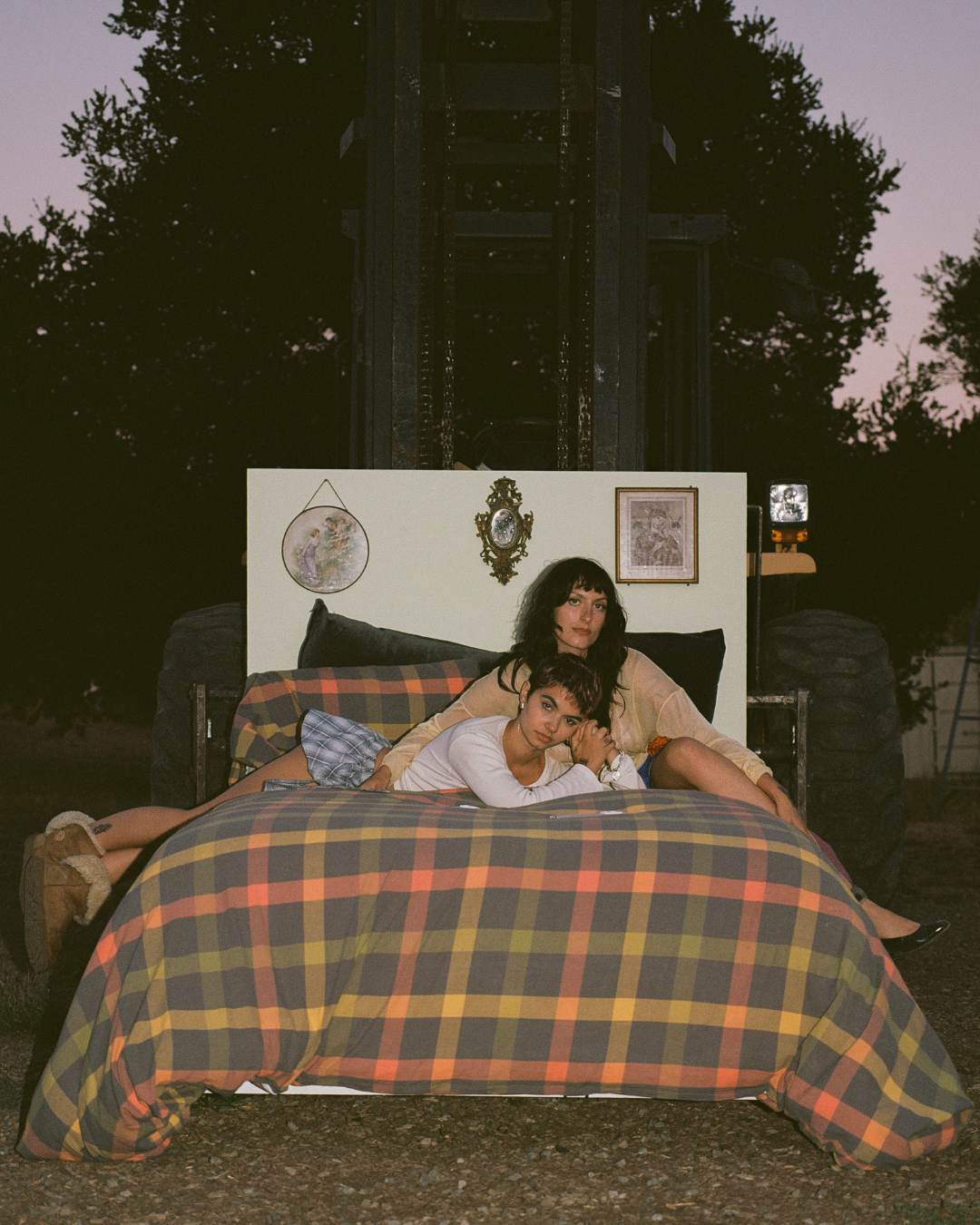
The Army, The Navy. Photo by Lucy Black.
What was it like to actually work with a larger team after working as a duo for so long? Did you have to leave anything from that former process behind, and then what are you going to take with you in the future of your career after working in that environment?
Sasha: It was so nice to open up the music to be bigger than us once we've invited people in, and so that was very new. You have to do it with people that you trust so that when they give their opinions on your music, you don't feel super possessive of it, you know? When you trust people that you're working with, you want to give them the grace to be able to follow their decision down whatever rabbit hole that they want to go down. Even though that's not necessarily your idea, you trust them to do that. It was so nice to work with more people, and, you know, collaboration is so important for us, and it just really can make music so much better to have so many bright minds working on something.
Tagging on to the collaboration aspect, I do have to ask about the harmonies. I feel like that's so integral to your music. I see a lot of people saying that your voices are soulmates. Do you guys agree with that and why? What actually is your process with coming up with those harmonies together?
Maia: I truly do believe that our voices are soulmates, and I also believe that we put in the effort to make them blend. You know, as much as I think we were meant to sing together, I truly believe that the universe had that plan. I do think we work really, really hard, and we're very intentional with our blend. We're constantly reminding one another to match each other, and it takes a minute for us to find our niche together and blend in that soulmate way. I also think our shared voice coach, Amber Morris, has a lot to do with that, because we were trained the exact same way. We had a little bit of an advantage to begin with.
Were you guys singing when you were younger? Was that something you guys grew up around?
Sasha: Yeah!
Maia: Yeah!
Sasha: Both of us.
Were you in a chorus or was it just a hobby?
Sasha: We were both in chorus in middle school; we were both in chamber choir, which was like, wake up at 6 am to get there at 7, and you sang your heart out an hour before school. It was so fun.
Maia: And then I was in an a cappella group, and we have been taking voice lessons for forever.
Amazing. What is it like to take the intimate vocal language that you guys have built all these years with each other on tour with you? You touched on this before, but sharing that with other people- what is it like to actually do that in a tour environment?
Sasha: It's a completely different beast. I think the second that you introduce amplification into singing, your technique has to be different. Maia and I can sit together and sing and sound great and blend really well, but then when it comes to having in-ears, our mix is completely different. So I don't really technically know how loud she's being, and she doesn't technically know how loud I'm being. It's really disorienting, and it takes a long time to get used to, especially when you're using any monitors. It changes everything. We have to completely learn how to perform and sing together live. It's like a new beast for us. I think that aside from the technicalities of it, singing and performing and sharing our voices with other people, like you were saying, I think it's one of the most, most, most special things that you could do as a singer.
I feel like the audience gets that too. You know, it's like seeing that connection and actually being able to hear it is super important! So, I have done a couple of interviews with artists who I would say are on the quieter side of the music industry. I find that quiet, as a form of power, is a really interesting theme I've been exploring. For you guys, who I also feel like are sort of on that softer side of music, what power do you think that quiet holds?
Maia: I feel like the softer side sonically makes everything more intimate, and it makes it much more vulnerable and scary to put out there, but I think it's very raw and real. I find that since our sound can be softer, the lyrics really cut through, which is something that's really important to us. One of our favorite parts about being musicians is writing the actual lyrics and having people understand and digest them. I think that's a real benefit in having that softer sound.
Sasha: And right when you said that, I immediately thought of Searows as being an artist that really has that powerful quietness. I think something that's so powerful about their music and also just quiet music in general is in those moments of silence; that's kind of when you can find yourself in the music, and you can project yourself into the music that you're listening to, and that's what makes it so powerful.
I feel like for this album, you guys branched out of that, and I feel like you did have some louder, more cinematic songs. What led you to decide to make the songs a little bigger on this project?
Sasha: I think some songs just kind of, you follow the heart of the song, and a lot of those songs needed that. I really think it's as simple as that. And I also think it feels so fucking good to make a song huge.
Maia: And angry!
Sasha: When you're in the studio, and it just goes in that direction, you follow it. And even if it's something that you're gonna scrap later, whatever it is, following what the song needs and it ends up being that big, it's so gratifying.
Tying into that, there were a couple songs on the album that stood out to me as louder, but also as powerful in their subject matter. “Pretty, Pink, and Soft,” and then “2 Collide,” were two songs that really stuck out to me. Why do you guys feel like it's important to empower these often-overlooked perspectives on love and loss that we don't really hear that often in music? Almost the non-victim side of things.
Maia: Naturally, it's so easy to write a song as the victim, and you'll see that in so many of our songs in general. I feel like a lot of the time we talk from the perspective of someone that's been hurt and is sad about it. And with “Pretty, Pink and Soft” and “Fake Brave,” it's kind of like this, too, and honestly “2 Collide,” because everyone experiences the anger in their own way. We had to get some of that anger and toxicity out of us and put it into the music. We had to be like, yeah, we can be sad and lovelorn and emotionally wrecked by somebody, but we can also be the person that has that capability, you know? Just being angry and strong and powerful on a song, especially as women musicians, is just so important for people to hear. We can get gritty and dirty and honest and not always be frail and fragile. Even though a lot of our songs are like that, like Sasha was saying, it's just so empowering to write a song from an uglier part of your soul and realize it's not even ugly; it's just another part of your soul that is harder to write about, honestly.
The album felt very well-rounded. I'm sure a lot of listeners experience the things that you sing about, so I feel like that was really nice to listen to.
Sasha: When I listen to “2 Collide,” I feel the way that you feel when you're like, huh!. Yeah, that's how it felt when I listened to “2 Collide.”
Maia: Me too.
Sasha: I feel you. Thank you for seeing me.
Of course! Now I am very curious about how you guys decide what the subject matter is gonna be for your songs! What is the songwriting process like?
Sasha: Ooh, how do we pick the subject matter? I guess it really depends. It's song to song. Since Maia and I spend so much time together, I've been through everything that she's been through. We're so familiar with each other's experiences, or even experiences that aren't ours, like our friends' experiences or whatever it may be. We both see the world on the same plane and are able to pull from that and write from those experiences. So, for example, songs that have nothing to do with us, we've been writing a lot about our friends, friends, boyfriends, breakups. We can go into a world and kind of blow it open and try to write a song about that. That's really fun. We've also been writing about random people that we follow on Instagram.
Maia: Our songwriting process is extremely collaborative. It normally starts with one of us playing around on a guitar and the other one hearing it and just finding some sort of inspiration, and then we'll sort of delve into a songwriting world. I feel like we never write songs being like, I want to write a song about the greenest grass I've ever seen in my life, you know, or something like that. I feel like usually somebody says a lyric or an idea, and if we like that idea/lyric, we just run with it. And that's kind of how our songs always come into fruition. But it does change case by case. Sometimes we have a theme we want to follow, and other times it's just completely random, and we just, you know, find inspiration.
Yeah! Reading some descriptions you guys have of your band, there are a lot of mentions of the natural world and how it inspires your music and songwriting. How does the natural world tie into your music, and how was the natural world used as an inspiration on this most recent album?
Sasha: I think that the natural world is so beautiful and there are so many ways to describe anything. I think sometimes finding the most nonsensical, different way to describe something is so much fun. I think the phrase "show, not tell" is something that Maia and I always try to follow. A lot of our songwriting is so inspired by Adrianne Lenker, who's such an amazing lyricist in the way that she writes about the world and the natural world and nature and creeks and rivers and trees. She's so amazing at showing, not telling, and just coming up with the most out-there ways to describe something. I think that's so inspiring for us, and we're so inspired by a world we love. It's so easy for us to write about trees and nature, and I think that those will always be themes in our writing forever.
Maia: And a big part of that is thanks to growing up in such a beautiful place. Like Marin County, you've got the redwood trees, you've got the beach, you've got hills, and the ocean. You've got so much beauty 360 around you, and I think growing up amongst all that beauty really made us write about it, want to write about it.
I also feel like it's interesting because as someone who grew up writing in school, you use a lot of natural metaphors. I don't know if that's maybe just something that I did when I was younger, but like, “it's as bright as the stars,” or “it sounds like the moves of the ocean.” I think it's cool to have that be pinpointed in music too. Love that. And then, just finally, what is next for you guys? What are you guys most excited for on tour?
Sasha: I am so excited to go on tour and finally play with a full band. That's so exciting for us. Maia and I start rehearsals next week. And I cannot wait to sing these songs for people and have them sing them with us. It's so amazing to sing them for the first time and hear people sing them back for the first time. It's always the best feeling, because they're yours for so long. For a year plus, they're just yours; they're like your secrets, and finally everybody knows your secrets, and it's so nice to hear them love your secrets. And yeah, just writing new music, being very excited about it, having it be very different. I think this industry and our job is ever-evolving, and it's definitely scary. There's no security in it at all, but it's such a blessing to do what we do. And I love it so much. And I can't wait for all of the new songs and all of the new faces. New faces, old faces.
Maia: Like Sasha was saying, I cannot wait to see how the live show comes to be. That's the most exciting part. And meeting everybody. I love meeting the people that listen to our music.
Stream Fake Brave Life out now and catch The Army, The Navy on tour this Fall!