
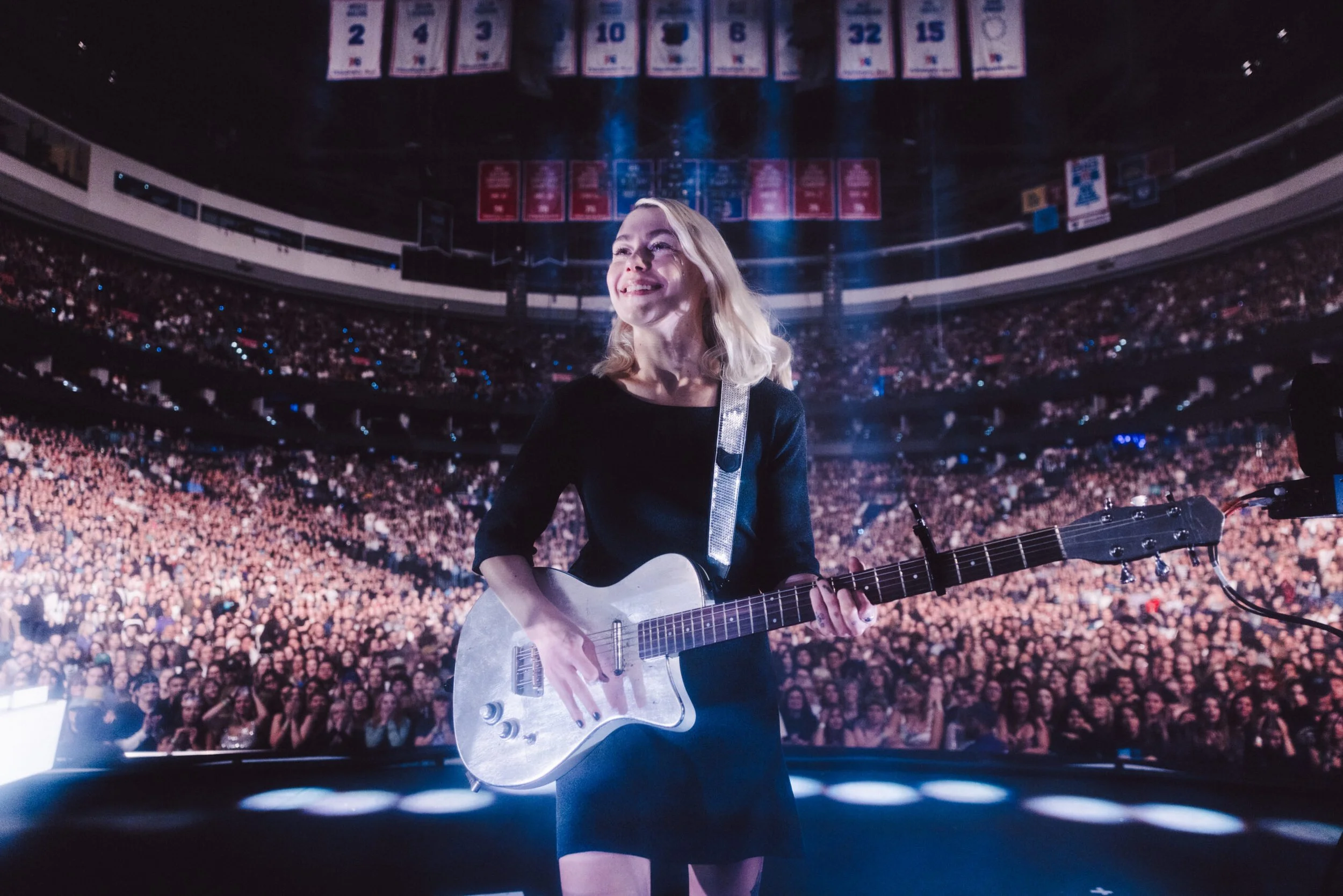
Phoebe Bridgers performing during the Lost Tour in Philadelphia. Photo by Matt Grubb.
When Phoebe Bridgers announced the release of her third studio album, Lost Weekend, in June, the internet was quick to hail the return of its “sad girl indie” queen: “lemme up my medication in advance,” commented one user under Bridgers’ announcement Instagram post. “no i was just starting to be happy again,” wrote another. With the virality of earlier, markedly melancholic tracks in her discography like “Scott Street” and “Waiting Room,” these comments were perhaps justified.
Until, of course, Bridgers dropped lead single “Lost Boys,” a track with a joviality fans had yet to hear from the singer-songwriter before. And it wasn’t a fluke. She sounds happy on most of the record. But what does it say about the state of musical engagement when listeners expect an artist to always be sad and are surprised — even mad — when they’re not?
In 2021, resident silken-voiced singer-songwriter Lucy Dacus had something to say about this notion in the following tweet:
“sadness can be meaningful but I got a bone to pick with the ‘sad girl indie’ genre, not the music that gets labeled as that, but the classification and commodification and perpetual expectation of women’s pain, also i don’t think my songs are sad, anyways good morning ☀️”
– Lucy Dacus, (@lucydacus) February 27, 2021
Though now deleted, the tweet is an oft-cited example used in different corners of the internet to challenge the aestheticization and reduction of female artistry and emotions. After all, the commentary came from inside the “sad girl indie” house.
Dacus was not the first artist to point out the dangers of making archetypes out of female musicians. The 1990s were a ripe time for young women baring their souls through song; artists like Fiona Apple, Alanis Morissette, and Tori Amos belonged to what was perhaps the first cohort of “sad girl” singer-songwriters. Descriptions of these end-of-the-century trailblazers often heavily lean on tropes of surface-level sadness cloaked in surface-level anger. In a 1996 feature, the Los Angeles Times called Apple “the hottest neurotic in town,” even after Apple faced such reductive classifications head-on in “Sullen Girl,” released just four months before: “Is that why they call me a sullen girl, sullen girl / They don’t know I used to sail the deep and tranquil sea.”
Watch Fiona Apple perform “Sullen Girl” Live on YouTube.
Turning to the 2020s, it’s not a stretch to attribute the repopularization of the “sad girl indie” label to the internet. When young girls can get hundreds of thousands of likes on TikTok lip-syncing to Lana Del Rey’s “Pretty When You Cry” and Taylor Swift literally releases a “Sad Girl Autumn” version of “All Too Well” to her 100 million monthly Spotify listeners, adopting the “sad girl” aesthetic signifies a certain level of cultural status.
In particular, I would argue that the term’s musical association reached a fever pitch in 2023 with boygenius’s return and subsequent mainstream success. When Dacus, Bridgers, and Julien Baker came together to create boygenius’s eponymous debut EP in 2018, the result was six tracks that were melancholic, yes, but, more importantly, were evidence of something deeper. They embodied the collective power reached when combining the shared emotional experiences of women to butt against the idolization of male counterparts — hence, the origin of the name “boygenius.”
The trio’s artistry was always rooted in friendship, but the theme of platonic romance was hammered home in 2023’s the record. “I’ll take everything you’ve got / Please take what I can give / I want to hear your story and be a part of it,” the group sings in three-part harmony on the album’s opening track, “Without You Without Them.” The record’s emphasis on positive relationships made it clear that boygenius did not want the complex emotions they wrote about to be reduced to the “sad girl” trope. Why, then, did The Washington Post describe All Things Go’s 2023 lineup — featuring boygenius, Maggie Rogers, and Lana Del Rey as headliners — as a festival where “sad girl music reigns supreme”? Why are the band’s tracks peppering “sad girl” playlists across the internet, including Spotify’s own “sad girl starter pack”? The supergroup’s mainstream success further fueled a media landscape that already commodified and reduced women’s emotions to the “sad girl” aesthetic.
Of course, the case against the “sad girl indie” label is nothing new, as evidenced by the boygenius members’ frustrations with the term, to name just one example. But 2026 offers an apt opportunity to revisit the argument, with so many of indie’s staple “sad girls” dropping new records. During the press tour for Ricochet, Snail Mail’s Lindsey Jordan said she feels “misqualified” when her music is added to “sad girl” playlists. And in response to fans’ surprise over the happy nature of her single “The light in the painting,” Lizzy McAlpine said, “I’m multifaceted … It’s always more nuanced than just, like, ‘sad music.’”
But what made me really want to unpack the “sad girl indie” label in 2026 was a conversation between Rolling Stone’s Angie Martoccio and Leah Lu about Bridgers’ Lost Weekend. In their 24-minute video, Martoccio and Lu rightfully point out that Bridgers is markedly not sad on her third studio album.
“This album really does a great job of being able to hold grief, loss, love, joy, and tragedy all in the same hand,” Lu said.
Watch Rolling Stone’s Angie Martoccio and Leah Lu break down Lost Weekend on YouTube.
Tracks like “Bobby” and “Liberty Tree” are drenched in a requited smittenness we’ve never heard from Bridgers before, while others like “Haunted” and “I Can’t Wait” clearly come from a place of introspective growth: “I’m not good, but I’m better / Missed my cue, but whatever,” she sings almost cockily in the latter. Even on the record’s more downcast tracks, Bridgers’ sadness is markedly more grounded and tangible than the all-consuming inward spirals present on Stranger in the Alps and Punisher, seen most in her tangles with grief on tracks like “Still Standing” and “Lost Weekend.”
Still, pre-Lost Weekend Bridgers could not be contained by the “sad girl” classification. Punisher staples like “Garden Song,” “Graceland Too,” and “I Know The End” are tinged with hope, resolve, and growth, and the ever-famous “Don’t be a stranger” line from Stranger in the Alps’ “Scott Street” acts as the harbinger of one of the most beautifully cathartic moments during her current tour. Having attended the Lost Tour in Philadelphia in September, seeing concertgoers embrace and sway together as the house lights went up during Bridgers’ performance of the song was a reminder of what music is about. Yes, music is emotional, and one of the most powerful universal emotions is sadness. But Bridgers’ music — and the music of other female artists confined to the “sad girl indie” label — has always been more than a two-dimensional depiction of sorrow. It's the catalyst for community — one that emerges when listeners feel moved together. Community is what gives music its true power, and that power can only be respected when we refuse to place artists in emotive boxes.