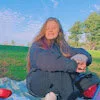
Old Moll On Music That Echo’s Through Time
The eclectic storytelling of Bristol’s Old Moll breathes new life into forgotten tales. The UK-based folklore- and history-obsessed musician draws on stories to spellbind listeners with dissonant harmonies, warm, layered guitar hums, and lyrics that drift between English and Welsh, encouraging us to understand the tales of our past and how they shape our present.
Moll's most recent release, "Venus of Malta," is a reverberating chronicle inspired by the prehistoric terracotta figurine depicting a woman's body, which shares the song’s name. This bright track encourages a love of body and reminds listeners that we are more than our physical selves; rather, our lives are part of a long, shared history.
Moll's upcoming release, Mothers of Mothers, continues her exploration of overlooked histories, uplifts forgotten voices, and reveals how understanding our past can illuminate our perception of both the present and ourselves. Moll sat down with Off The Record to discuss her creative process, her love of folklore, and the timeless power of storytelling.
How did you start your music career? When did you start? How did you get into music?
I've been playing and singing since I was a teenager. I started doing gigs and open mics in my home city of Bristol, UK, and, really, I started Old Moll 3 years ago as a solo acoustic project. I just wanted an avenue to express my obsession with history and folklore, which is still what I want to this day. It's grown from me, on my own, to having a full-piece band with me, making music with me, which is fantastic. It's been a long, old journey and broken up into a lot of different things, but I feel like I finally landed, which is very nice.
What drew you to folklore and history to where you wanted to make music about it?
My music has always been a response to my inner world, and folklore and history became more of my entire world in the past few years. It's one of those things that I dimmed as a teenager, as you do, but I have always been so interested in it, and folklore has always been a massive part of my life. So many folk customs and folk traditions were part of my life growing up. I'm from Somerset in the Southwest of the UK. There are so many unique things from my childhood that I didn't realize were that at the time. It was everything from the Maypole celebration of the first of May and the coming of spring. I was always the tallest one dancing around the Maypole, which was embarrassing. They've always been part of my life, and I moved away for a time, and it was when I moved away that I didn't realize quite how much those customs and history were part of my life.
Anything that I feel particularly drawn to comes out in my music, so it was that real yearning for home and feeling part of something bigger than myself, which I think is essentially what folklore is. That really drew me to start writing about it in my music, and as soon as I was writing about it, I thought, oh, this is the music I'd always been meant to write.
When it comes to your sound, do you have any influences? It does really go along with the folklore because it's kind of ethereal and deep.
Everyone always expects an artist who's influenced by folklore to be super folk-aligned, and I can never seem to fit myself into one pocket when it comes to that. I'm a real indie girl. My parents loved Blur; they loved Oasis. I'm never going to be able to escape my indie upbringing. I was obsessed with Wolf Alice as a teenager, and I'm still obsessed with them now, to be honest. I think more of that indie sound has sort of translated into my sound right now. A lot of ethereal keys, fuzzy guitars, they all seem to find their way back.
I love Wolf Alice. I'm a huge Wolf Alice fan. I also feel like I found Wolf Alice when I was a younger teen.
They grow with you as well. I feel like they've definitely grown with me as a person. It seems they meet me where I am whenever they release an album. I love it.
Just so cool. Getting into your music specifically, though, your most recent song, “Venus of Malta,” references acceptance of bodies and generations of people. Why do you think it's so important for people to find fractions of themselves in art? What is the importance of the form of storytelling for your music?
For me, especially in the last week, “Venus of Malta” never felt more poignant to me. One of my favorite artists, CMAT, is an Irish artist who performed at Radio One's Big Weekend a couple of weeks ago. It seems like over and over again, she just gets stupid amounts of hate and abuse online for her body. It just always comes back to that idea that people have that there is just one type of body that we should be seeing, and that is something that even the internet, in all its sprawling glory, seems to have narrowed it down to as though it's just one type of body that is acceptable.
For me, seeing the Venus of Malta at the Museum of Archaeology in Valletta was that moment when I was like, "Oh my god, she looks like me, and she's 5,000 years old.” That's older than Stonehenge. I think there's something about Neolithic art in particular. It just smashes our perceptions of what it means to be alive and to inhabit a body. For something stretching back so far, and for something to look like you, and for a body like that to be, not only have existed but been revered and loved enough to be put down and to be sculpted in clay for me to see 5000 years later is just mind-blowing. Everybody on the internet who is giving hate to CMAT right now, I just want to send them a picture of that statue, being like bodies like this have been around for thousands of years. So, there's that side of it. It's seeing yourself and there's that acceptance part of it, but I think seeing yourself as part of something bigger is the more important thing. No, not the more important thing. There's 2 sides of the same coin, right? It's seeing yourself reflected in art, but also in humanity as a whole.
In the age of AI, there's something so healing in seeing the fact that humans have been making art for thousands of years, and that's the pinnacle of human expression. The first humans who went to space also coincided with the first art made in space; we just can't stop ourselves from doing it. It takes you out of your box of time, if that makes sense. [...] If there's anybody out there that listens to it and sees the statue and thinks, okay, things aren't that bad, my body is not something that needs to be fixed, it's done its job.
The art itself reminds us that we're all human, and what we see online doesn't reflect reality. This sort of gets into my next question! With the theme of folklore and humanity, in what ways do you think that music has the power to connect us to our past and our present? And in what ways are you trying to do that through your music as a medium?
Humans have always been storytelling creatures. That's been the way that we see, and we understand our world, and I think music is such a perfect way to do that, and folklore does that as well in terms of the specific stories and the specific tales that happen in each region. We're seeing across America, we're seeing across the UK, the rise of the far right and the need for authoritarianism to construct that one narrative. It's like this is where you come from, this is your culture, this is what your culture means, this is what your ancestors did, because that helps them channel their power, I guess. But there's something, especially in the UK, about celebrating regionalism.
People think of England, Wales, Ireland, and Scotland as an amorphous blob, and it's not that at all. Even with England, where I'm from, each region has such amazing, diverse folklore, and folklore that pops up across different regions as well. I'm focusing on that difference and that diversity as well. It’s a beautiful, rich tapestry, and there are so many different stories that come in from other places through migration. That adds to this beautiful tapestry of people living their lives in one place. Folklore has a mission to disrupt the single story that, ironically, keeps us all apart. Music is such a great way to do that because, especially at live shows, it brings people together in a room and helps them move in ways they might not otherwise be able to.
I am really curious. For your songwriting, is there a trigger that you have where you're like, I have to write about this story?
Anything that makes me feel like I've stepped out of my own life into something else. Often, when I write about folklore or history, there's always something going on beneath the surface. When I was writing “Venus of Malta,” I was really questioning my body and going through a different relationship with it. When I wrote “Silver Hare,” I was thinking a lot about violence against women and girls, and cycles of abuse. Really, they bubble under these stories. That is what always drives me: I feel the subject has a really strong narrative. I've just got so many books on folklore, and there's one in particular, which is the folklore Bible, it's the Folklore, Myth, and Legends of Britain. It's divided into different regions of the UK and loads of folklore from each part. One of my favorite things to do is just open it on a random page, pick a story, and start writing. Often it will just start building itself, and sometimes it really surprises me because there are stories that I'll read and I think, oh yeah, I'll just write about that for a bit, and then it just sort of latches onto whatever's going on in my life or whatever is important to me and just takes some mind of its own, really.
What about the name? Where does Old Moll come from?
My artist name, Old Moll, is taken from a Dartmoor folktale. She was a witch from Dartmoor, which is an area of Devon in the southwest. “Silver Hare” is about the story of Old Moll, and she was able to turn herself into a hare. Hares have been associated with the moon, magic, and transformation for thousands of years in Britain. It was said she could transform into a hare, and I was just really comforted by that story.
I feel like it ties together so nicely, like making stories out of stories that are gonna become stories. There's like this wide web. Getting into your community a bit, I know you call it your coven. Is there a reason that you did that? How does that all tie together?
I am a witch myself. A coven is a community of witches, a community of women, and I think that's really what I want to bring into the forefront. A community of people, and it's not just a one-way communication with an artist. I want to try to open up these opportunities to chat, grow together, and share the things we love. I always want to tell women stories as well. My song “Winter in the Summer Country,” which I'm going to re-release on my EP in a couple of months, tells the story of the woman in my family, all the way back to the 1700s. If anything, I just want my music and my community to lift these stories up. These stories of women who were previously pushed down and ignored, as if they weren't seen as history or worth writing down.
I love it! I have talked to a couple of witches in my time. I just love the community. I think it's so beautiful. As for a silly question, if there is a mythical creature that could have your music as its background theme, what would that mythical creature be, and why?
Oh my gosh. I'm obsessed with bogs. Loads of people are obsessed with bogs at the moment. There's this folk story about Jenny Greenteeth, who's supposedly a water spirit. I feel like I make music for the people of the bogs. So, I'm gonna go with her. She's a bit of an interesting one. She's not exactly good, but you know what? Sometimes you gotta be a bit angry. I'm a wetland girlie, so I'll go with her.
And then my final question is just, what does the future of your music look like? Are you releasing anything in the future?
My new EP, Mothers of Mothers, is coming out next month, and I'm really excited about it. We're hoping to go on a mini tour with the band in the autumn. I've never been on tour before, so that'll be a big step. I'm already thinking about the next EP. I'm really interested in the concept of folklore for the future and our actions today being written down as, what are they gonna be? How are people gonna perceive us in the future? That's really grasping my attention at the moment, so I've already started workshopping a few ideas.