How Bella Litsa Surrenders To A Drastic Life
For Bella Litsa, to fully live is to sink into the extremities of love, loss, and everything in between. After nearly seven years in the making, the Brooklyn-based artist unleashes an unraveling of her own human experience and its magnitude in the form of her debut album, Drasticism. Across 11 tracks, the singer excavates feelings that lie deep beneath the surface and glosses them over in baroque pop soirées that soar beyond the cosmos.
Litsa hopped on a video call with me to talk about the making of Drasticism, answering an emotion when it knocks, and how a German animated bunny became a source of inspiration.
What feelings come up when you think about the word “drasticism” now that the project is out in the world?
I feel really proud of what I did with the band and all the people who worked on it with me. It’s a lot of pride and relief.
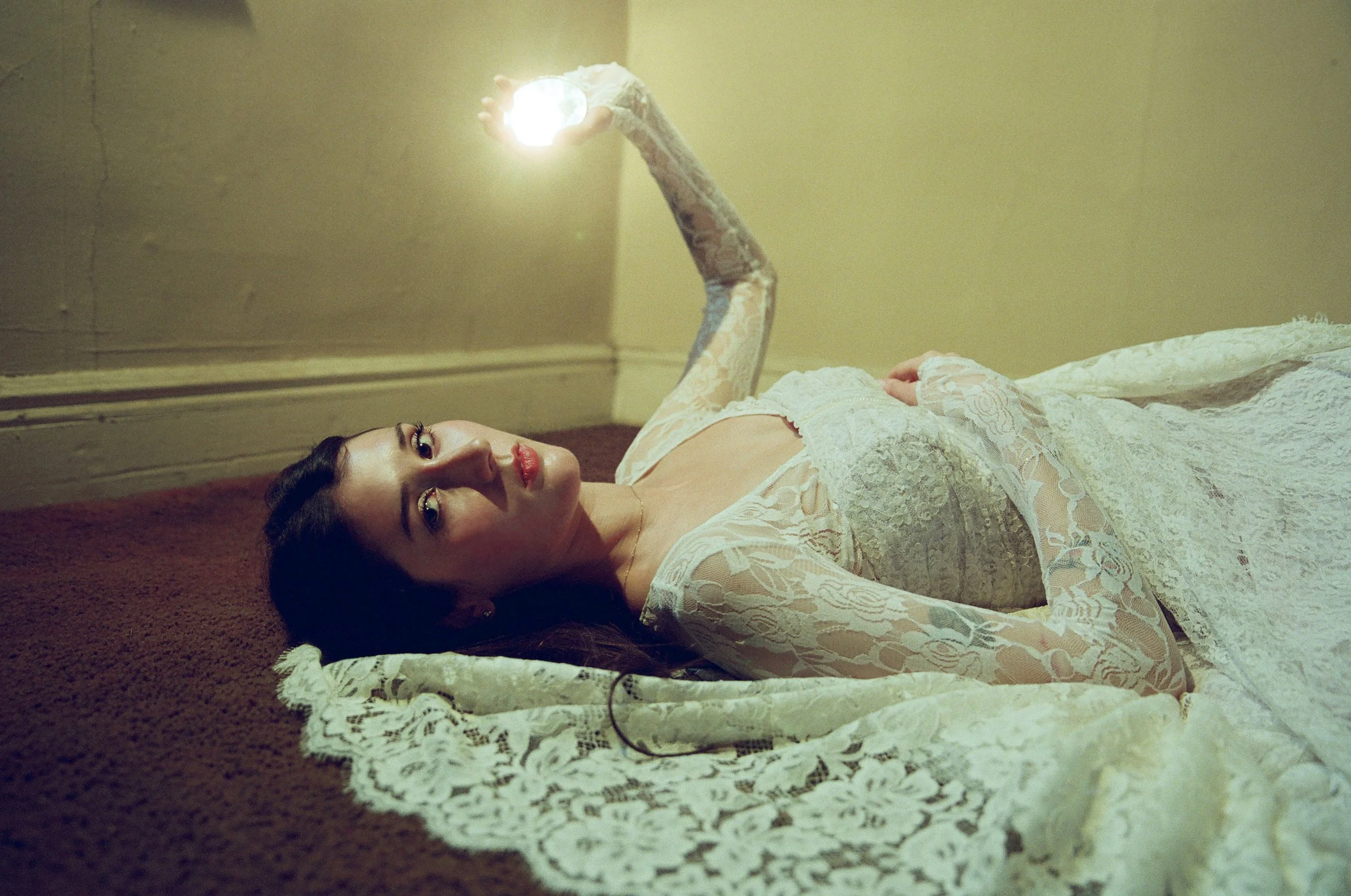
Photo via Grandstand Media.
There's a sense of intimidation, too, with it, and maybe it's because I was working on some music earlier. Right before we jumped on this call, I'm like, “Will I ever be able to write again?” Maybe I don't need to compare anything that I'm doing now to Drasticism, but it's a whole combination of things.
But it's a lot of relief and gratitude for how it all came out, and how it all has been received is really special.
You describe your songwriting process almost as a practice of breaking yourself down to uncover songs that have always been there, waiting to be found. Have there been moments when making Drasticism where you’ve been surprised by what you discovered about yourself?
Totally. There's probably a bunch of lyrics that I was like, “Oh, I'm gonna say that, I guess.” It’s funny –– they change in meaning over time. I'll listen to a song from the album, and I'll think, “Oh wow. This means something completely different than I thought,” but then I can't remember it. It appears, and then it kind of just disappears.
There's a lot of surprise in the lyric writing. I would say mostly songs like “1117” were really a “Why did I say that type of thing?” or “Why did I want to say that?” and “The Fall” because those feel like the two most emotional songs. When I was writing the lyrics, they came really easily, and I was like, “Oh, why am I saying that?”
Now I have a better idea, but it was the lyric writing that always surprises me.
How do you determine what you want to share and what you want to protect?
Are you into astrology?
A lot of my friends are. They kind of teach me
It’s fun. I can kind of explain it through astrology, but I'll just say I have a Scorpio Mercury, and I think it’s a big part of what I decide to share and what not to share. I'm always leaning towards not sharing anything too specifically.
A lot of my lyrics I write to be very veiled. What the exact topic or thing that I'm talking about might not be really clear. I think it comes from a sense of not wanting to give too much of myself away.
I still feel like I'm expressing the emotion in its entirety, but the narrative and all the details don't necessarily need to be there. I like a more abstract description of situations, and that it can also just be up for interpretation. But then there's a certain level of protection I feel from that still.
Your lyricism is beautiful. From start to finish, the album is packed with rich storytelling that almost needs to be dissected line by line. What’s a lyric or two you wrote that encapsulates Drasticism’s energy as a whole?
I think my favorite lyric is from [“Tied Together by a Silver Thread”]. “Play the piano like you're my composer / And pull out the strings in my heart / It won't bother me.” This whole album felt like such a surrender to love, and being really intense in love. Subjugating or not subjugating, but throwing myself to the wind.
Maybe this is a cheap take, but I really like the end of “Angelica.” The last lyric is “La la la la,” and I put it there as a placeholder. I was like, “Oh, I'll write a lyric,” but I grew to love the very nonchalant nature of it. It's the last song, and there are all these other songs that you've just listened to. It’s up and it's down, and it's left and right. And then the last thing I have to say is really just like “Gah. But, whatever.”
There are strong themes of movement threaded throughout the album, whether that be sonically, like the drum patterns in “Saint Mishima,” or visually, like in the music video for “Passion Plug.” Does your relationship to dancing or playing the piano inspire how you approach a track’s instrumental progressions or vocal runs, even unconsciously?
Yeah, I mean totally. I think they're all connected unconsciously. So to try to answer it as accurately as possible, is probably impossible because some of it I don't understand.

Photo via Grandstand Media.
I never wanted my music to feel jarring, I guess. I grew up dancing – I'm not like a super serious dancer – but I grew up doing it, and it always was something I really loved. I still love it.
There's an elegance that you have in your body, no matter what style of dance you’re doing. To get to this dance move, you have to transition into it, and then you transition out of it. It’s never just one move, one move, one move. There's all these interlocking steps that have to connect everything. I think that seems very similar to how I write music.
I would add certain passing chords –– or even in “My Blue Eyes” –– there's a middle section where it kind of explodes. I still didn't want it to come out of nowhere. I wanted it to breathe into it a little bit. It still gets big, but that was a huge thing with all these transitional moments. I wanted all the parts of a song to fall into one another, which I think is similar to dancing.
I think about artists like Lana Del Rey or Bon Iver who are known for creating a language through their melodies that helps you understand things you can’t quite articulate through words. When I listen to your music, I feel a similar effect that invokes something in me I didn’t realize I was feeling. Almost like a sense of nostalgia. Is there an influence heard in the record, or artists you were listening to during the process that people wouldn’t expect?
I think Bladee. I love Bladee so much that I don't know how he wouldn't influence me.
I made a playlist of songs before we started recording. It was just like, “Okay, what's the inspiration? What songs, or what sounds, are gonna inspire me for this?” It was a lot of Lana, John Maus, Daft Punk. Roy Orbison is a huge one. A lot of classical music. But I don't know. Maybe those are all pretty obvious.
There is this one. It's not a band. I don't even know how to describe it. But it's this German-pop musician from 2008ish, and the name of the group is Schnuffel. The artist is this animated bunny.
Schnuffel is really inspirational to me. There's this song, “Häschenparty,” and I mean, it's ridiculous. It's very pop. But I think that type of music is also really inspirational to me. I think they have beautiful melodies. It's definitely a little bit out there. I don't sound anything like it, but I love Schnuffel.
With songs written across a couple of years, it’s evident that a lot of tender care and intention went into the album. What practical tools do you use to nurture and remember those emotions?
I journal –– I've honestly been pretty out of practice. But “Saint Mishima,” for example, I was really devastated one day, and I was laying in my bed. It was September when I wrote it. I was staring out the window at this tree, which is something that I've done my whole life. Growing up, I remembered feeling very similarly. I'd be in high school devastated over something and just staring at the window at this tree. I was doing that, and inconsolable, and the lyrics to that song –– I just wrote them while I was in this emotion. “The Fall” was this different emotion I wrote months removed from the situation that it was about.
Sometimes, they speak to me, they want to be feelings. They're like, “Okay, right now you’ve got to write it.” Or sometimes they just fucking sit there for months, and then they rear their heads. It always changes, and god, it's so annoying.
You caught me in a funny mood because I'm trying to write songs and I'm like, “Oh my god, I feel like I forgot how to do it.” I don't know if I can afford to be as patient this time for whatever's next, but we'll see.
Drasticism has an incredibly rich visual language that brings us into your inner world. What did the drawing board look like when you were brainstorming your album cover?
I mean, it all starts on Pinterest, right?
I don't have a very strong visual sense, I think. I've never really felt that. I always really look up to other artists around me. I had a ton of help. The people that I was working with –– the photographer for the cover and all the directors for the music videos –– they brought so much to it. I have inklings of ideas and things I think are beautiful and things that I maybe don't think are, but to really hone in on any visual, it was with the help of many people.
I was lucky. I feel like I chose people to work with who I was friends with and who I felt I already had a simpatico connection with creatively. It all seemed to come together in a way.
Which song off the album ignites that “drastic” or extreme feeling in you?
I think it’s “The Fall” right now for me, personally. It’s been my favorite song to play live.
I know what I wrote it about, kind of. But it must be something else too, because I feel like I'm still processing it. Every time I play it live, it gets really intense for me, and I get really into it in this way that always surprises me.
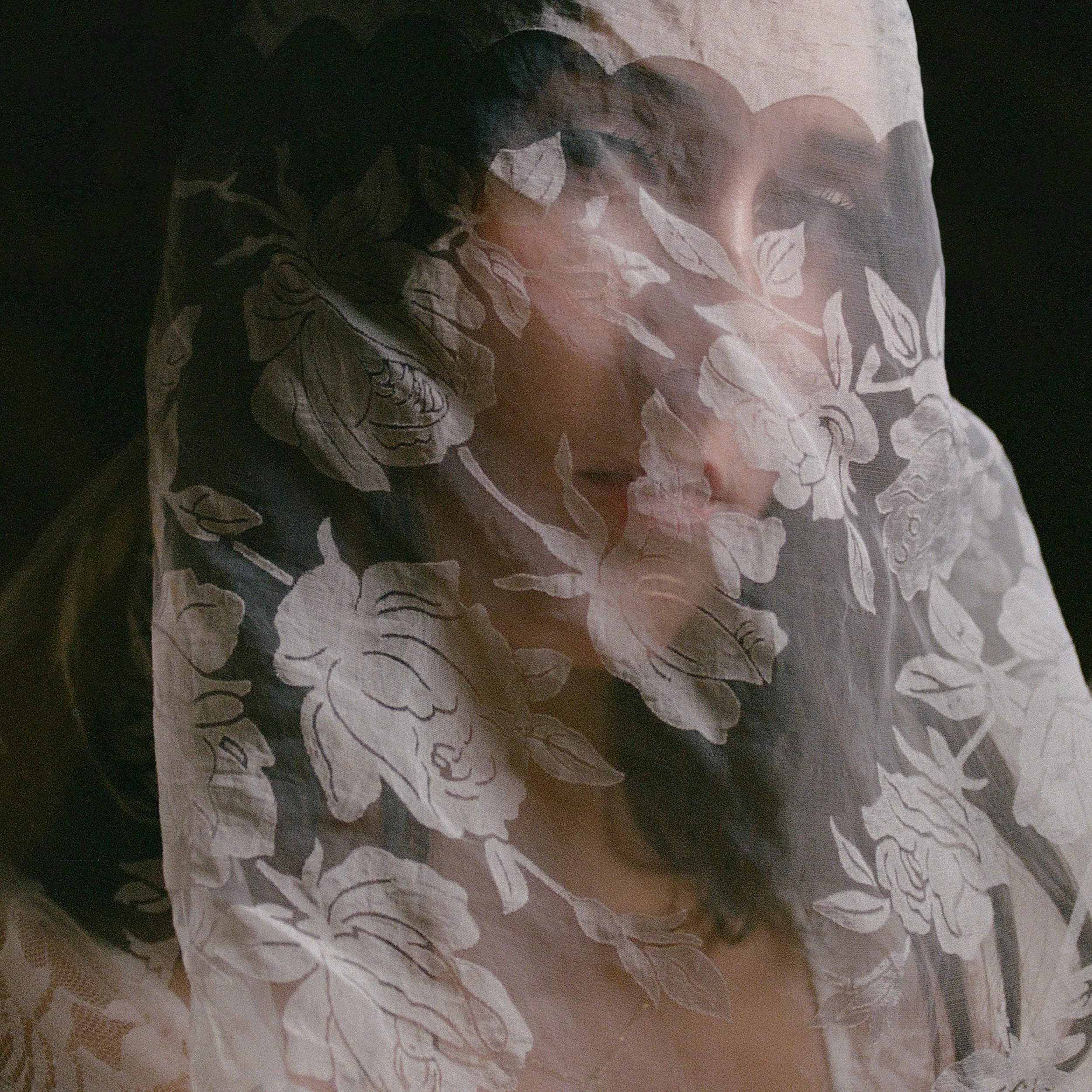
Photo via Grandstand Media.
I used to feel that way with “1117.” That’s the goal –– when you're playing music, you're not thinking about the music, you're thinking about the feeling. I feel like for “The Fall,” that still happens for me. It’s a very overwhelming song, which is what I wanted it to feel like.
Is it scary to bring that to a stage in front of a bunch of people? Or do you get lost in the feeling and block everything out?
I think I totally get lost. I think playing like that is so much easier because you forget what the situation is. It’s a really cool transference of energy. If I can give that much, that means people are open to it.
That’s what people go to shows to see. They want to see that level of like presence and intensity. It’s a presence that live music, when channeled, is really powerful. I hope that's how it comes off. It feels very powerful for me.
It doesn't really make me nervous because it just feels so good. I think it's nice when I'm not thinking about the music as I'm playing it. Cause then I’m like, “Oh fuck, I'm gonna mess up” or “Ah, I gotta hit these notes.” It’s nice to let go of all that.
What is one thing you hope your listeners take away from Drasticism?
Maybe a sense of love. I love people so much. I know how the world suffers because everyone experiences it firsthand, to a degree. I hope that if someone's going through something, they can listen to the music and feel held in that. And feel like it's okay to be sad, or to feel crazy, or whatever it is. It’s a part of life. I think that is really important to me.